Center takes pressure off struggling companies









Unique venture helps businesses save time, money and secure funds all in one place
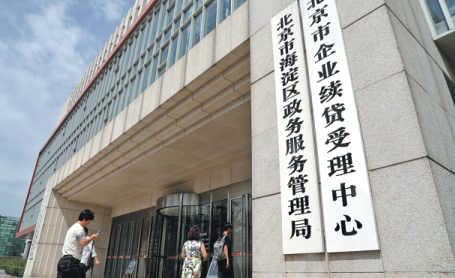
Enterprises in Beijing struggling to pay off working capital loans as well as needing new loans have found remedies thanks to a center built by the Haidian district government and the Beijing Bureau of the China Banking and Insurance Regulatory Commission.
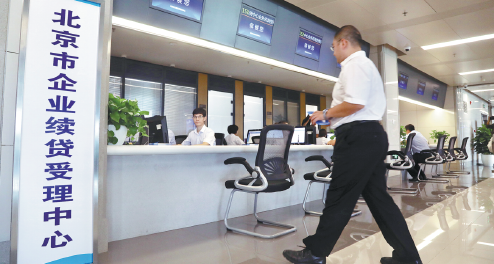
The center, which opened in August 2019, mainly serves small and micro businesses that face temporary financing problems when their working capital loans approach their payment deadline.
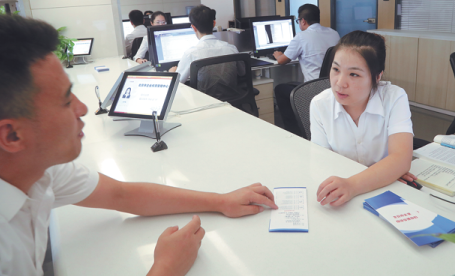
After application, evaluation and approval, these enterprises can receive a loan from banks in the center to pay back the previous one.
As China's first business loan renewal center-that integrates government departments, banks, an industry regulatory group and agencies-the facility is aimed at reducing the cost of securing finance for enterprises, maintaining ethics with loan officers and improving the efficiency of credit approval, said Li Junjie, deputy head of Haidian district.
According to Li, the center has set up its office in the Haidian district government affairs service hall.
"There are representatives from 15 banks and a bonding company in the office. It is very convenient for enterprises, as lending, loan renewals and mortgages can all be dealt with here," Li said.
The center has also adopted a standardized procedure, which has reduced the application documents needed and shortened the approval time, according to the Haidian district government.
Previously, applicants had to submit 20-50 documents. Now it is 14 at most and applicants will receive an answer within 10 days. So far, the fastest approved project took two and a half days to finish the procedures.
Among beneficiaries of the center is Beijing Chenggo Advertising, a company that had a bank loan worth 3 million yuan ($435,260) before.
Under the previous procedure, it would take two months to return the money and reapply for the loan, said Gao Guoqing, chairman of Chenggo."But now, we only need to provide basic information and the whole process for approval was two weeks."
By the end of 2019, the center had dealt with 321 applications for loan renewals. They approved 316 of them with a combined amount of 1.99 billion yuan.
Applicants are mainly from emerging industries including mobile internet, bioengineering, new materials and new energy.
Since opening, the center has saved more than 60 million yuan in financial costs for enterprises. The average financing cost has decreased by 3 percent, according to staff members at the center.
For the next step, the center has announced eight measures to further solve enterprises' financial problems and improve Beijing's business environment.
Haidian district will cooperate with the People's Bank of China and integrate the bank's personal credit information system at the center.
"We will install a self-service machine in the center to help enterprises obtain their credit information and support the center's loan business," said Zhu Xiaojing from PBOC. The system is currently being trialled.
Incentive policies will be issued to encourage financial institutions to offer more loans, said the Haidian district government. Government aid in the incentives is estimated to reach nearly 10 million yuan a year.
The center will also collaborate with the National Intellectual Property Administration and the Copyright Protection Center of China. These authorities will jointly build a fast track in the center for enterprises to pledge their software copyrights, patents and trademarks.
Other planned measures include conducting cooperation with more intermediary agencies, establishing a blockchain-based financial service platform for small and medium-size enterprises, and releasing a list of enterprises that should be focused on by financial institutions.
The list of the first batch of enterprises in Beijing's Zhongguancun Science City has been determined. It includes 402 startups and 40 unicorns, which refers to high-growth startup businesses each valued at over $1 billion, Li said.
zhanglinwan@chinadaily.com.cn