Ford reports improved performance, growth in China market









US carmaker Ford Motor Co is seeing signs of steady recovery in China thanks to a raft of dedicated measures that boost its competitive edge in the world's largest vehicle market.
Thanks to lower structural costs, Ford's fourth-quarter operating loss in China was 61 percent smaller than in the same period in 2018, according to its 2019 financial results released this month.
Last year's final quarter was the fourth straight quarter of year-over-year improvement in China for the second largest carmaker in the US.
Ford's China performance was one of the highlights of its global financial results. Its adjusted Q4 earnings before interest and taxes were $485 million, down 67 percent. In 2019, Ford's adjusted free cash flow was $2.8 billion, flat compared to 2018.Revenue was $155.9 billion, down 3 percent year-on-year.
Analysts say Ford's continuous improvement in China implies its the lackluster performance in recent years will soon end.
They attribute the achievement to the carmaker's localization campaign in the country, which includes new vehicle launches, better service quality and improved dealership networks.
Ford China announced its transformation blueprint in April 2019 to bring together the "Best of Ford" and the "Best of China".
The blueprint marks a change in the company's approach to its China business, after it was named in late 2018 as a standalone business unit reporting directly to Ford's global headquarters.
As part of this transformation, Ford is launching more than 30 vehicles over the next three years, of which more than 10 will be electrified vehicles. The company said a lot of the over 30 new models will be specifically designed for the Chinese market.
"The success of any global company operating in China lies in ensuring Chinese consumers are at the core of its business," said Anning Chen, president and CEO of Ford China.
The company launched several new models in the country in 2019, including sedans and SUVs. It launched three-the new Focus Active SUV, the Edge ST/ST-Line SUV and the new Taurus-on a single day last August.
The models have brought about significant changes. For example, the Ford Territory sold 12,083 units in the fourth quarter, bringing full year sales to 42,669 units. Those figures made it the best-selling Ford SUV in the China market last year.
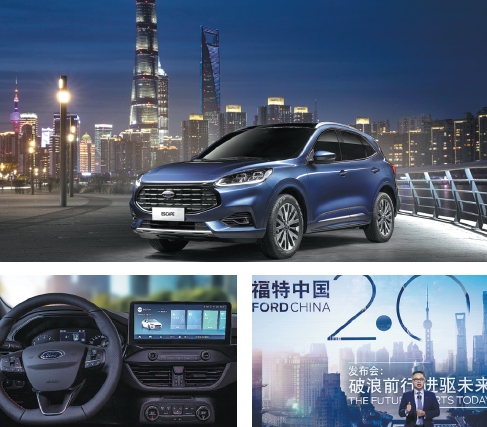
The all-new Ford Escape launched in late December has attracted wide attention among Chinese consumers. Customer traffic to dealer showrooms and orders placed have been much higher than expected.
Ford's high-end brand Lincoln is speeding up its efforts to introduce new models as well, including the Nautilus and the Aviator. At the end of 2019, Lincoln kicked off the presales of its Corsair model, the first localized model for Lincoln in China. Lincoln said it will begin delivering the all-new Corsair to Chinese customers in March.
Analysts said Ford is steering back on track and laying a foundation for the future. They explained that one of the biggest reasons for Ford's sales slump over the past several years was a lack of new models in the world's largest market where rivals are launching new cars.
A growing lineup of models from affordable vehicles to more premium automobiles has also helped boost Ford's image as one of the most successful international carmakers.
Dealers are finding improvement in their situation as well because Ford has introduced a sales-based production plan, which prevents dealership overstock and improves the company's manufacturing and marketing efficiency.
By the end of June 2019, the average dealer stock stood at 28 days, much better than the industry average and the lowest level in 18 months, said Jason Yang, president of Ford's national distribution services division in China.
In the second half of the year, over 50 percent of dealers were making money, despite the overall sales downturn in China's vehicle market.
Ford has come up with measures to help tide dealers over during the novel coronavirus outbreak. The epidemic has forced customers away from dealerships.
Among other things, the company has canceled dealers' sales targets in February, extended interest-free loans for dealers and raised commissions for salespeople.
Ford is also stepping up efforts to equip its vehicles with its latest technologies. Last year, the carmaker debuted its SYNC+, a new in-vehicle infotainment system powered by Baidu's artificial intelligence technology.
It said from 2019 the majority of new domestically-produced Ford and Lincoln vehicles will come equipped with SYNC+, a next-level connectivity experience that was developed specifically for Chinese drivers.
Ford said the majority of new models sold in China will also be equipped with its advanced driver-assist technologies, including Adaptive Cruise Control and Lane-Keeping Assist, to deliver Chinese customers a safer and less stressful driving experience.