Collaborations between China and US increase









Scientists from both nations cooperate more on coronavirus research despite tensions
Scientists in the United States and China, the world's top two producers of scientific research, are collaborating more on COVID-19 research despite mounting political tensions, a series of studies have found.
"We were quite surprised by our results.… Our findings indicate that the two nations are conducting the most COVID-19 research, and they're continuing to collaborate more with each other than with any other countries," said Jenny Lee, a professor at the Center for the Study of Higher Education at the University of Arizona, during a recent webinar.
"The rate of collaboration increased significantly-5 percent-over collaboration prior to the pandemic. It's also higher than the rate of collaboration on non-COVID-19 research," she said.
Lee, along with John Haupt, a doctoral candidate at the center, conducted studies on US-China scientific collaboration through bibliometrics (statistical) methods. Their latest study, published last month by Higher Education: The International Journal of Higher Education Research, examined the patterns and nature of science co-publications between the US and China over the past five years.
Challenging US political rhetoric and attempts to curb international research engagement with China, their findings show that China plays a leading role in US-China research collaboration, based on first authorship and governmental funding patterns.
While members of the US government and many lawmakers accuse China and its nationals of stealing intellectual property from the US, the research found the opposite: China is actually leading in US-China co-authored studies, said Lee.
She said the studies also debunked the so-called "China threat", as the findings showed that over the past five years, US research article publications would have declined without Chinese co-authorship.
While US publications have remained relatively steady, China's rise has been about twice as fast as the world's average. Just a few years ago, China surpassed the US at the top position in science publications, according to Lee.
"The US needs China more than China needs the US when we look at the rate of scientific publications," she said.
Global leaders
The US and China dominate the global scientific system by being the two largest producers of scientific knowledge and two largest research collaborators in the world; when combined, the two countries account for over half of the world's scientific articles over the past decade, according to Lee.
Using positive-sum framework, Lee and Haupt's study demonstrates US collaboration with China benefits both the US and global science, especially at a time of global health crisis.
But Lee warned that US President Donald Trump's administration's "barriers" are challenging the global science system. Prior to the pandemic, the US has already proposed numerous policies to decrease scientific engagement, especially with China, including denying visas for Chinese students and researchers, banning Chinese funding sources and developing protocols to monitor Chinese scholars in the US, said Lee.
Barriers to science
According to a 2018 survey by the Union of Concerned Scientists, a science advocacy organization, more than 63,000 scientists in 16 federal agencies reported interference from government officials, with 50 percent indicating that political interests hinder the ability of their agencies to make science-based decisions.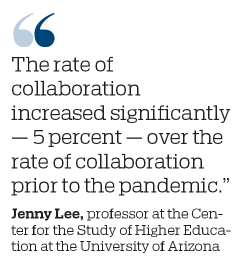
In handling the COVID-19 crisis, Trump's administration ordered all hospitals to bypass the US Centers for Disease Control and Prevention and submit all coronavirus data to a different federal agency, said Lee, adding that an earlier survey of CDC scientists found the greatest barrier to science-based decisions was the White House.
The challenges have included reports of scientific studies being halted, edited or suppressed, the sidelining of scientific advice, and political oversight over grant reviews, she said.
"For example, a major NIH(National Institutes of Health)-funded study on how the coronavirus moves from bats to humans was suddenly defunded without clear evidence of wrongdoing," said Lee. "Scientific experts expressed concern because this study countered conservative US political and media claims that the virus escaped from a laboratory in China."
The White House has strategically aligned the COVID-19 threat with the previous "China threat" narrative-labeling the coronavirus a "Chinese virus", placing the blame squarely on China, she said.
liazhu@chinadailyusa.com