Special economic zone proves its credentials with rapid growth









When Shantou is mentioned, beef balls, kongfu tea, seafood and a variety of mouthwatering snacks will come to the mind of anyone who has been there.
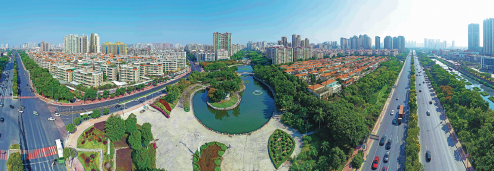
However, the special economic zone in South China's Guangdong province is also likely to leave a lasting impression.
Located in East Guangdong, Shantou is a major ancestral origin of many overseas Chinese, which is among the significant reasons why it entered the list of China's first four special economic zones in 1980, together with Shenzhen and Zhuhai in Guangdong and Xiamen in Fujian province.
Many experts attributed Shantou's sustained development in the past four decades to the generous investments of overseas Chinese, their development ideas, their business resources and even their donations.
Official statistics indicate that Shantou has secured over 5,000 foreign-funded projects involving capital inputs of $9.38 billion in the past two score years, 90 percent of which are funded by overseas Chinese whose roots can be traced back to Shantou.
Shantou was allowed by the State Council to set up its overseas Chinese economic and cultural cooperation experimental zone in 2014, marking the only national reform and innovation platform focused on "overseas Chinese".
"Shantou is at its prime time now with strategically important positioning. Our officials at all levels are full of vigor to make the city better," Wu Xianhong, chief of the Shantou development and reform bureau, told China Daily recently.
In October 2018, Shantou was given a new role as a major pole to build a modern coastal economic belt. It was later clarified in a document of the provincial government that it would serve as a subcenter of Guangdong.
"We are optimistic about the new positioning and will go all out to catch up with better developed cities in the province," Wu said.
Industrial development has been given priority to lead the city's economy, he stressed.
To be specific, the city will focus its efforts on upgrading three traditionally strong industries and fostering three new sectors, Wu said.
The traditionally strong industries are textiles and garments, handicrafts and toys and chemical and plastics, which target an annual industrial output of 100 billion yuan ($14.6 billion) each.
Its textile and garment industry, for instance, contributed nearly one-third of the city's total industrial output, close to 100 billion yuan in 2019.
Its toy industry is strong with a full chain ranging from design, raw materials and components to packing, sales and exhibition.
New industries planned
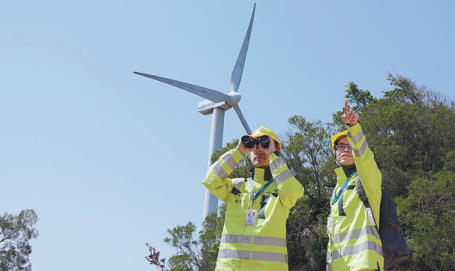
Besides the upgrading of traditionally strong industries, Shantou is attracting new investments and projects to three coastal sectors. They are the offshore wind power industry, harbor-based industry and green petrochemical industry.
The new development will highlight Shantou's leading role in building a modern coastal economic belt in the eastern part of Guangdong.
According to a plan for the province's offshore wind power development between 2017-30, it plans to install wind power generators of 1.85 million kilowatts in shallow-water areas while the power generation in deep-water areas is to reach 33.5 million kilowatts.
China's three leading power corporations-Three Gorges, Datang and Huaneng-have been working on the construction of wind-power projects in phases. The projects will transform the power supply in the coastal regions of Southeast China, which mainly depends on coal power, Wu said.
Shanghai Electric Group has set up a smart production base in Haojiang district of Shantou to produce wind-power generators. With a total investment of about 500 million yuan, the project is expected to produce an annual output value of 6 billion yuan, Wu noted. More importantly, it can attract companies in the industrial chain to invest in Shantou, he added.
Policies rolling out
To fulfill this plan, the city government has issued policies to designate land for industrial use in all districts and counties to solve land shortages. The city highlights whole-section land development and has reclaimed seven sections of land respectively in its Haojiang, Chenghai, Chaoyang and Chaonan districts for industrial use. Currently, land lots totaling an area of more than 70 square kilometers have been made ready to attract new investment projects, Wu said.
The city aims to develop at least 10 high-level development zones by 2035 to help the influx of industrial companies.
The city government arranged 301 major projects, including infrastructure, industrial projects and public facilities, at the beginning of this year with an aggregate investment of 37.6 billion yuan. An additional batch of 77 projects were added to the package in the second half of this year, pushing the total investment to 42.2 billion yuan.
These projects will improve road, rail and harbor connectivity in and out of the city, lay the foundation for economic and social development and enhance people's living standards.
Meanwhile, it will forge closer cooperative ties with Shenzhen and other cities in the Guangdong-Hong Kong-Macao Greater Bay Area, to take advantage of their innovations, industries, technologies, funds and talent and make best out of Shantou's advantageous industries and the city's position as a major ancestral origin of overseas Chinese, according to the local government.
In August, a Shenzhen-based telecommunication giant opened an industrial internet innovation center to build a public service platform for Shantou's intelligent manufacturing.
The industrial park where the center is located is the first in East Guangdong to focus on artificial intelligence. It aims to consolidate the capital, human resources and industrial resources in and out of China with a root in Shantou and surrounding areas.
chenhong@chinadaily.com.cn