Time line









Exhibition in support of the application for world heritage status for Beijing Central Axis highlights its historical and cultural significance, Wang Ru reports.
In 1951, Chinese architect and architectural historian Liang Sicheng stressed the importance of Beijing's north-south central axis in his article, Beijing-the Incomparable Masterpiece of Urban Planning, saying: "Beijing's unique magnificent order was generated by the establishment of the central axis. Beijing's undulating and symmetrical shape and space distribution is based on this axis."
His highlighting of the importance of the central axis in the design of Beijing laid a solid foundation for the protection and world heritage application of the axis today. "Liang gave a clear definition of the axis. Seventy years later, we are still moved by his pride in ancient Chinese culture sensed between the lines, and I feel proud to work as a protector of the axis today," said Lyu Zhou, vice-president of the Chinese National Committee for the International Council on Monuments and Sites, at the opening ceremony of an exhibition about the axis at Jingshan Park on Sept 29.
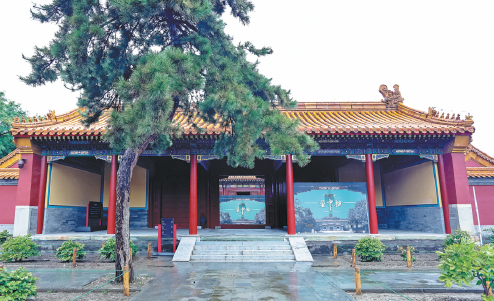
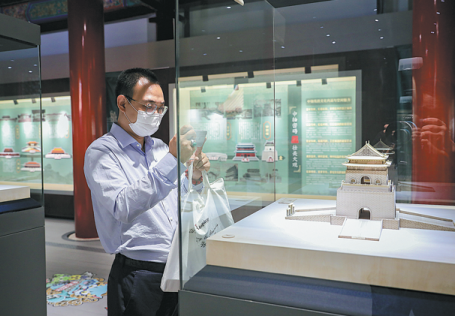
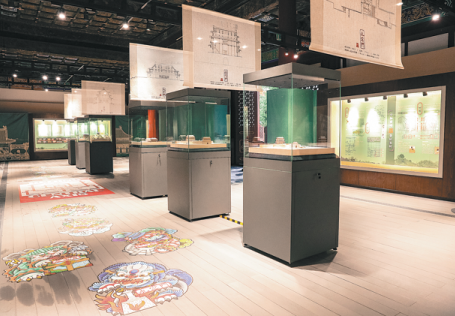
Organized by the Architectural Design and Research Institute of Tsinghua University, the National Heritage Center of Tsinghua University and the management office of Beijing Jingshan Park, the exhibition, A Panoramic View of Beijing Central Axis from Top of Jingshan Park, runs until Dec 20.
"We hope our protection of the axis will motivate the protection of Beijing's old city areas. Although many professionals are working on the protection, it still needs support from all sectors of the society," says Lyu, who is an architecture professor at Tsinghua University.
"We want to make people understand more about the axis and the necessity to protect it through the exhibition, so that more people will support our protection work."
The axis has a history of more than 750 years. It stretches about 7.8 kilometers from the Bell Tower and Drum Tower in the north of the capital to Yongding Gate in the south. Many iconic sights in Beijing, such as the Palace Museum, the Temple of Heaven and the Imperial Ancestral Temple, are located on or alongside the axis.
According to Xiang Dechun, deputy director of Beijing's municipal administration of cultural heritage: "The exhibition will play a big role in raising awareness of the value of the heritage sites along the axis and introduces the work we have done to apply it to be identified as a world cultural heritage. The axis belongs to China and the entire world as an important cultural and historical heritage, so we want to make it better known internationally, and introduce China's aesthetic ideas."
Exhibitions about Beijing's central axis have been held many times before, but usually focusing on some particular aspects related to the axis such as the historical cultural and creative products that were produced along it. This one is more complete and systematic, according to Lyu.
The exhibition has three parts, introducing the concept and history of the axis, the application for it to be identified as part of the world's cultural heritage and the future development of it.
"The axis not only reflects the lifestyle of ancient Chinese society, but also serves as a living carrier of traditional Chinese culture and value," says Zheng Chuhan, an engineer at Architectural Design and Research Institute of Tsinghua University.
In ancient China, the central axis was viewed as integrating the political idea of the "center brings power", the ethical thought of the "center creates justice", and the aesthetic tradition of "beauty and virtue are combined", reflecting the concept of the ideal capital that originated in the pre-Qin period (c.2100-221 BC), Zheng says.
Throughout Chinese history, the capitals of many dynasties had central axes, but Beijing's is the only one that remains and still plays an essential role today, according to Lyu. "For example, the central axis of Chang'an, one of the capitals of the Tang Dynasty (618-907) has long become a historical site. People in today's Luoyang city can no longer see the central axis that existed in the Sui (581-618) and Tang dynasties.
"Although the axis of Xanadu is still visible in its site in Xilingol League of northern China's Inner Mongolia autonomous region, it's just an archaeological site and is no longer in use today."
Since the axis is still in use in Beijing, it is not only about history and culture, but also about modern city life. According to Liu Yulong, deputy dean of Architectural Design and Research Institute of Tsinghua University: "We believe that protection of the axis combines historical and cultural heritage protection with modern city life, and integrates the historical and cultural connotations with those of modern life to create a better future."
Contact the writer at wangru1@chinadaily.com.cn