Kering major part of bold future of luxury in China









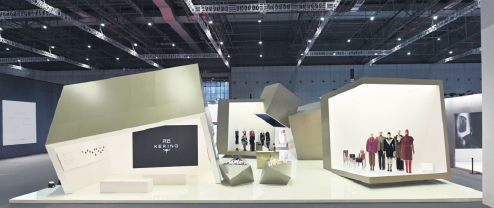
Kering returns to Shanghai for the second year to attend the third China International Import Expo, showcasing its creative universe in an Ole Scheeren-designed pavilion. You can't miss it: it looks like a dynamic mass of cubes in various sizes and shapes resembling jewelry boxes.
The pavilion is a fitting stage to get to know a little more about this international leading luxury group, home to 13 luxury houses, which are Gucci, Saint Laurent, Bottega Veneta, Balenciaga, Alexander McQueen, Brioni, Boucheron, Pomellato, DoDo, Qeelin, Ulysse Nardin, Girard-Perregaux and Kering Eyewear.
If you've ever bought a Gucci handbag or a Brioni suit, a stop by the pavilion is a "must" to immerse yourself in Kering's world of "Empowering Imagination".
And here in Shanghai, you'll see how big a role China plays in this world. For instance, the limited edition Marine Chronograph Quantieme Annuel watch by Ulysse Nardin featuring a panda-inspired face; Boucheron's Goutte de Ciel ("Drop of the Sky") necklace featuring NASA's scientific material Aerogel from the current Haute Joaillerie series; and a vintage 1960s dress from Balenciaga alongside a new 2020 creation, illustrating how classic style and values are still relevant and modern today-another form of "sustainability" that has a strong focus on China.
Deep roots in China
Being present in China is nothing new for Kering.
"China is a key market for the global luxury industry and Kering has been successfully operating in China for over four decades," said Cai Jinqing, president of Kering Greater China.
"From the first Gucci boutique in Hong Kong in 1974 to today, our stores are now present in 42 Chinese cities and most of our houses have launched permanent miniprograms on WeChat."
The first Gucci boutiques in Beijing and Shanghai opened their doors in 1997. Today, Kering employs more than 6,300 people in China.
Chinese luxury consumption continues to outpace the overall market, and China's interest for Kering's houses remains unabated, even during the pandemic.
"We have not seen any major shift in the customer's mindset before and after the outbreak, which we believe is mainly due to their confidence in the government and the overall recovery of the country," said Kering Chairman and CEO Francois-Henri Pinault.
While Kering shuttered several stores for some weeks during the lockdown, customer relationships remained close thanks to digital and social channels, and the group continues to accelerate its online presence in China's ecosystem.
"Customer expectations toward luxury brands are rather reinforced after the crisis," Pinault added. "Luxury contributes to aspirational lifestyle and the construction of identity, which is more necessary now than ever. I see that luxury is now part of their personal story and journey."
Generations of inheritance
Luxury is also part of the personal story and journey of Kering's nascent family dynasty. In 2005, after taking over PPR founded by his father, the younger Pinault used his market knowledge, intuition and a proven track record to transform what had been a retail conglomerate into a luxury powerhouse-a synergistic group of brands focusing on fashion, leather goods, jewelry and watches. Kering's signature-"Empowering Imagination"-rests on the principles of creativity, innovation and sustainability.
PPR was renamed Kering in 2013. The name derives from the Breton word Ker, meaning "home", while its Chinese name Kai Yun is phonetically similar to Kering and means clearing the sky, or opening infinite possibilities for imagination and creativity. Thus, "Kering" suggests a home where ideas can flourish.
"We hope that our strategic vision will empower people to reimagine the luxury sector in the future-full of creativity, audacity and authenticity, based on best practices for biodiversity conservation and caring for the earth and its resources," Pinault said.
There is a close relationship between luxury and sustainability, according to Kering.
"Our houses' products begin their lives in farms, fields, forests and other ecosystems around the world," said Marie-Claire Daveu, Kering's chief sustainability officer and head of international institutional affairs.
"For instance, Kering sources organic silk from China; our wool comes from New Zealand and Australian rangelands, and our viscose comes from sustainably-managed forests. Thus, when we protect natural ecosystems and local biodiversity in these areas, we protect the birthplace of our products."
In 2017, Kering's houses purchased 16 metric tons of organic silk, all coming from China.
Looking ahead
Sustainability also reaps the benefits of acceptance and loyalty from a younger generation of consumers, and ensures that quality products will be available for years to come.
Since 2005 Pinault has put sustainability at the heart of the group's core strategy, establishing a dedicated sustainability department in 2010. Six years later, Kering was named by Corporate Knights as one of the world's top 100 sustainable companies, ranking second in the textiles, clothing and luxury goods sector and becoming the only luxury goods company to receive an award.
By January 2017, Kering had embarked on a new phase in its sustainable development strategy aimed at halving its overall carbon footprint by 2025 by creating new business models geared toward sustainable development.
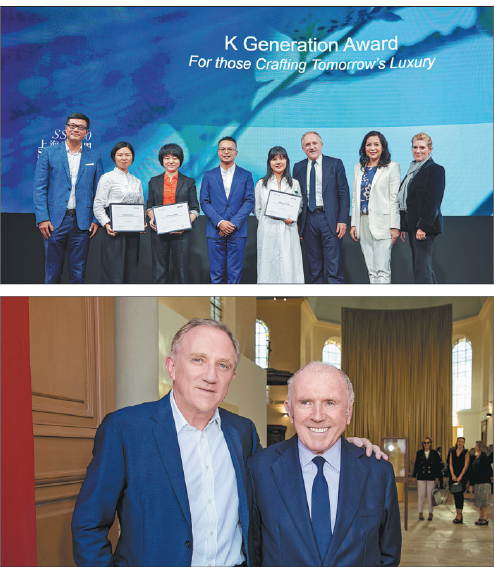
Coupling sustainability with innovation, in October 2019, Kering, with its partner, global innovation platform Plug and Play, inaugurated the "K Generation Award" to recognize and fast-track sustainable innovation within the luxury and apparel sectors in China.
The first-place prize went to Melephant, a startup addressing sustainability challenges in the textile value chain, and includes comprehensive mentorship and networking, travel to Europe and the United States to meet with fashion and innovation leaders, and a grant of 100,000 euros ($117,000).
The same year, French President Emmanuel Macron gave Pinault a mission to bring together the leading players in fashion and textiles to set practical objectives for reducing the industry's environmental impact.
Chinese industry leaders such as Ruyi Group are among the 60 companies that have signed the pact, together accounting for roughly 35 percent of the global textile industry.
Pinault has a singular vision for the modern, bold luxury sector of the future. "Creativity is still the soul of the luxury industry," he said.
"The outbreak has undoubtedly made the necessity for environmental change even stronger. In China and with China, we can strive to make our industry more sustainable to lead the world to change fashion for the better."