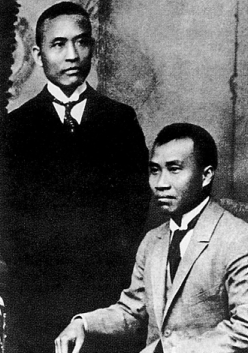
Memory of Chinese marshal kept alive in Germany









GOETTINGEN, Germany-At a university town in central Germany, a yellowed piece of paper containing student registration details from the 1920s and a former residence have been preserved in memory of a student who later became a founding father of the People's Republic of China in 1949.
Zhu De, a native of Sichuan province, was 36 years old when he began studying at the University of Gottingen in 1923. The university library still keeps the registration paper with his handwriting, and it indicates that Zhu studied sociology at the department of philosophy.
Sociology was then a new discipline at the prestigious university founded in the early 18th century. Zhu's choice was vastly different from other Chinese students at Gottingen, most of whom chose to study medicine, chemistry or other natural sciences.
While most of the Chinese students were in their early 20s, Zhu came to Gottingen as one of the first Chinese communists and an experienced army officer. Born in 1886, he took part in the 1911 Revolution that overthrew the last imperial dynasty in China and had fought in various wars in the country.
Zhu met Zhou Enlai in Berlin in 1922, and joined the Communist Party of China through Zhou's introduction. They both saw the CPC, which was founded in July 1921, as the only remedy to save a war-torn and poverty-stricken China bullied by imperialists. As part of a group that founded New China, Zhou became New China's first premier, while Zhu ranked first among the top 10 marshals of the People's Liberation Army.
"Zhu was not young, and he had spent many years in the military," says Rolf Kohlstedt, a historian at the Goettingen City Archive. "He wanted to expand his vision here, in an industrialized Western country."
The city archive keeps Zhu's residence registration paper from the local police, a yellowed document with a photo of the 36-year-old man in a suit and tie. It recorded his move from Wilmersdorf, Berlin, to Goettingen, his temporary lodging at Planckstrasse 3, and his return to Berlin in December 1924.
At Planckstrasse 3, Zhu lived with a local family. The two-story red-brick house is still intact and has become an essential pit stop for tourists at this university town with a population of 120,000.
In 1986, a marble plaque was attached to its facade, with the inscription reading "Zhu De, Marshal of the People's Republic of China, 1923-1924", in commemoration of his 100th birthday.
Apart from his studies, Zhu devoted himself to the work of the CPC. As head of the Chinese students' association in Gottingen, Zhu actively promoted communist ideas and the prospects of New China among students who were eager to know more about their home country.
Dagmar Yu-Dembski, a specialist on China studies and honorary president of the Confucius Institute at Free University of Berlin, says historical documents, including memoirs of Zhu's friends and coworkers, show that he gained important insights in military strategies and publicity skills.
The city archive still keeps an application filed by Zhu and other Chinese student leaders to the local police department for a demonstration, with an attached flyer entitled "What's going on in China?". It condemned a massacre of students and workers in Shanghai in May 1925, demanded changes to the miserable living conditions of the working class, and solicited international support for China's fight against imperialism and colonialism.
Zhu was arrested twice for his involvement in revolutionary activities before he was expelled from Germany. He later studied military affairs in the former Soviet Union and returned to China in 1926.
However, his activities in Goettingen are still remembered almost a century later.
"His name is often heard, and we are all proud to tell others that we are alumni of the same university as Zhu De," says Wang Jiawen, president of the Chinese students and scholars association in Gottingen.
Xinhua