Creating memories









The new Shanghai Expo Culture Park showcases the legacy of the 2010 World Expo, Xing Yi reports.
The Shanghai Expo Culture Park, which is located on the former site of the 2010 World Expo in Shanghai, opened its 85-hectare northern section to the public on Dec 31. During the New Year holiday weekend, around 50,000 people visited the park, taking photos with the legacy pavilions of the expo, roaming in the newly built traditional garden, and playing with their pets in a designated zone.
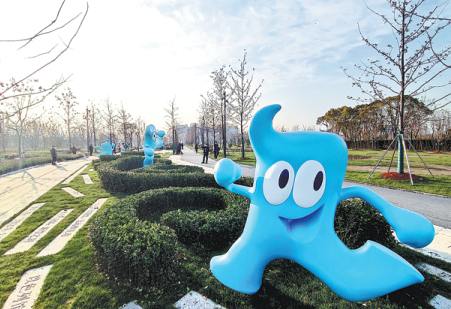
"I worked as a volunteer at the expo 12 years ago. Those pavilions and the sculpture of the mascot Haibao in the park bring back good memories of the old days," says Guo Sijia, who was among the first to enter the new park.
About 170,000 volunteers, most of them university students, worked for the expo from May 1 to Oct 31, 2010. The major event spanned 528 hectares and received more than 70 million visitors, both record highs in the history of world expos.
"The expo experience left behind many fond memories. Many of my classmates were volunteers and many of my relatives went to see the expo," says Guo. "I will definitely try to organize a class reunion or a family trip in this park."
After the 184-day expo, most of the temporary pavilions were demolished while the permanent buildings were turned into museums, shopping malls and convention venues. The expo's China Pavilion became the China Art Museum, and the World Expo Cultural Center became the Mercedes-Benz Arena.
Park for people
In a legacy plan for the expo area, made in 2004, the place where the culture park now sits was reserved for retail, trade and office uses.
"The land would be worth more than 100 billion yuan ($15.7 billion) if it was developed into a commercial zone according to the original plan," says Sun Yi, general manager of the Shanghai Expo Culture Park Construction Management Co.
"However, the old plan was shelved after the expo ended, and in the spring of 2017, Shanghai decided to transform this site into a park which can be compared with Hyde Park in London and Central Park in New York," he says.
Xu Dongxin, director of the greenery department of the Municipal Administration of Landscaping and City Appearance, says the construction of the 200-hectare park is in line with the city's 2017-35 master plan that aims to turn Shanghai into an "excellent global city".
"Shanghai needs skyscrapers, but it also needs more parks and lawns," says Xu.
"Returning the expo legacy site to the citizens as a public park is a perfect continuation of the Shanghai expo slogan-'Better city, Better life'."
Before the construction of the Shanghai Expo Culture Park started in the autumn of 2017, the municipal government launched several rounds of consultation with the public, and more than 1,300 ideas on how to build the park were collected from respondents, says a report by Jiefang Daily.
Wu Zhengjiang, a retired employee of the former Shanghai No 3 steel plant, had in 2017 proposed building a hill in the park. He says that waste from the plant, which used to be located within the park in the 1960s, eventually formed an artificial hill in the area.
"I couldn't believe that my suggestion was adopted and the hill will soon become reality," says Wu, who was interviewed by Jiefang Daily again when the park opened.
A 48-meter-high hill in the park will be hollowed out to host park management offices, power substations, equipment rooms and vertical parking lots. A grand opera theater, a conservatory and an equestrian area are still under construction in the southern section. These facilities are expected to be completed by 2024.
Other suggestions from residents, such as connecting the culture park with the nearby Houtan riverfront park, have been adopted. A 1.35-kilometer stretch along Shibo Avenue that once separated the two parks has been transformed into an underpass to provide people with greater convenience when moving between the two areas.
Past reminders
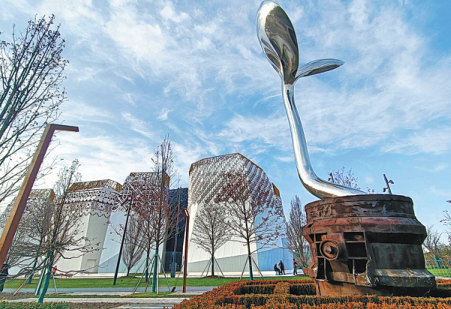
In the northern section of the park, pavilions of France, Russia, Italy and Luxembourg have been renovated to attract tourists.
Xia Bing, deputy Party secretary of Arcplus Group, which came up with the master design of the park, says there were many challenges in preserving the legacy pavilions because they were designed to be temporary structures.
"We had to perform extensive structure strengthening and replacement of materials to meet anti-seismic requirements and other safety standards," he says. "At the same time, we maintained their original facades so that they would serve as a reminder of the grand event for future visitors."
The renovated France Pavilion is already hosting weekend flower and wine fairs up to Feb 15. The other three pavilions will be used to host exhibitions and provide catering services, according to the park's management company.
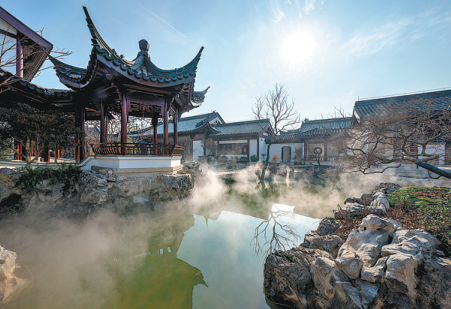
Another featured attraction in the park is the traditional garden called Shenyuan, or "Shanghai garden", which is twice as large as the iconic Yuyuan Garden located in the heart of the city. The new garden is holding a bonsai-and-stones exhibition and a lantern show to celebrate the opening of the park and the upcoming Spring Festival.
Xia says creating a traditional garden in the modern metropolis is a form of tribute to the Jiangnan culture of the Yangtze River Delta where water towns and private gardens have been built since ancient times.
The company has also designed a 400-meter boulevard in the park that showcases the industrial history of the area, as well as events from the 2010 World Expo.
"They are all parts of the city's memory," Xia says. "They show how our city has evolved for the better."
Contact the writer at xingyi@chinadaily.com.cn