KUNG FU ICON









Bruce Lee's legacy still inspiring 50 years after his passing
The man, the myth, the legend. Bruce Lee was all of these things and more. On July 20, 1973, the world lost one of its most iconic and influential figures when Lee died suddenly at the age of 32. Yet, half a century later, his legacy lives on, larger than life and more resonant than ever.
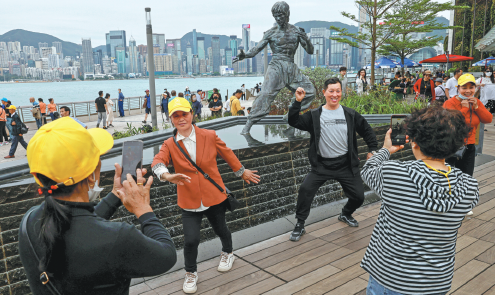
Tourists flock to the Avenue of Stars at the Victoria Harbour waterfront in Tsim Sha Tsui, Hong Kong, a place of pilgrimage for Bruce Lee fans from around the world.
They pause at Lee's bronze statue to pay tribute to the martial arts master, often laying flowers at the base of the 2.5-meter-high sculpture that showcases Lee's classic Jeet Kune Do move, inspired by his final complete film, Enter the Dragon.
Some pay their respects with a simple bow or a moment of silence while others perform their own martial arts routines in front of the statue, channeling their inner Bruce Lee.
Shin Yong-woo from South Korea is one such fan who had traveled more than 1,600 km to pay homage to his hero. He stood before the statue, dressed in black pants and sporting his bare chest, just like Lee frozen in frame by the monument. With a nunchaku in his hands, Shin began his performance, twirling the weapon with fluid precision. A fan since he was 9, Shin credited Lee with inspiring him to learn Chinese martial arts.
Born in San Francisco in 1940, Lee spent much of his childhood and formative years in Hong Kong, where his father was a well-known Cantonese opera singer.
It was in Hong Kong that Lee began to study martial arts. As one of Hollywood's most influential Chinese-American actors, Lee presented Chinese martial arts and its underlying culture and philosophy to the world through his films, and even introduced the term kung fu into the English language. His confident portrayal of Chinese culture in martial arts movies continues to inspire people.