Pianist's music brims with the joys of spring









After years in the UK, Xiao Di is a big part of its Spring Festival, Xing Yi reports in London
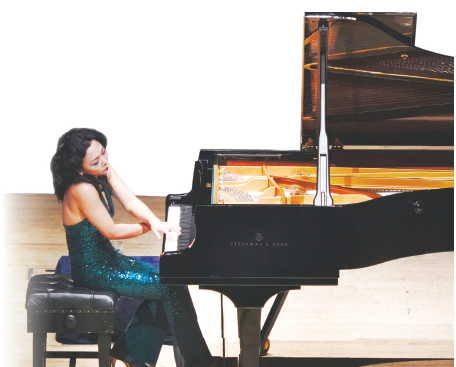
After living in the United Kingdom for almost 20 years, pianist Xiao Di is fluent in Mandarin, Cantonese, and English — but she believes music is the best language for promoting understanding between people and cultures.
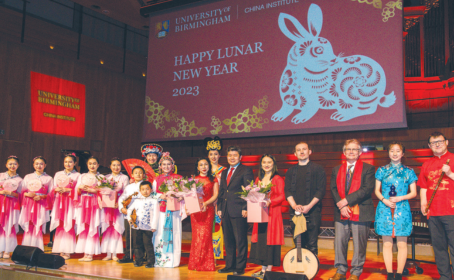
Since 2012, during each Spring Festival, Xiao holds a concert in the Elgar Concert Hall in Birmingham, known as the "Didi & Friends Chinese New Year Celebration".
The concert series involves musicians from different genres giving performances at an event that mixes Chinese culture with Western music, offering British audiences another way to celebrate the traditional Chinese festival.
"One of my aspirations is to be a cultural ambassador, using art to break down cultural barriers and bring people together, and it's a role I take very seriously," said Xiao, who was born in Guangzhou, Guangdong province, and who started learning piano at age 4.
She went on to train at China's top music institution, the Central Conservatory of Music, where she took her bachelor's and master's degrees.
Later, she finished a doctoral degree at the Royal Birmingham Conservatoire and became the first Chinese piano professor at the renowned British music institution.
But the start of the Spring Festival concert series was humble.
"In the beginning, it was only me and two other friends, who were invited by the China Institute of the University of Birmingham to give a small concert to celebrate the Lunar New Year," recalls Xiao. "We played classical chamber music, but the audience felt that it lacked Chinese elements for the Chinese festival."
During the following years, Xiao tried to introduce Chinese music and other creative elements, such as Chinese opera and Chinese instruments, and she invited other musicians, both professional and amateur, to join in and showcase their talents.
This February, the concert featured 16 artists, including solo percussionist Wang Beibei, Chinese traditional dancing artist Zhou Hangyu, and Sichuan opera artist Zhao Shuai, who gave performances to a packed house of 600 people.
British musicians Max Gittings and Mike Skelton also contributed, playing the Chinese traditional instrument hulusi, or gourd flute, and the sanxian, a three-string lute.
"The Spring Festival concert has become an annual cultural highlight in the city," Xiao said, adding that Mike Whitby, a member of the House of Lords, and Li Liyan, cultural minister counselor at China's Embassy in the UK, attended this year's concert.
Due to COVID-19 restrictions, Xiao could only hold online concerts during the preceding two years. When the restrictions were lifted for this year's event, the tickets sold out in five minutes.
"I was so moved when I saw the hall was full of the audience again," said Xiao. "It motivated me to continue organizing the Spring Festival concert, and next year will be the 12th edition. It will be significant to the project because 12 years are a cycle in traditional Chinese philosophy."
Xiao arrived in the UK in 2005, studying under a full scholarship at Birmingham Conservatoire under Mark Racz. After completing her studies, she was selected for the European Concert Halls Organisation's Rising Star program for the 2008-09 season, during which she toured Europe and gave recitals in prestigious venues in the Netherlands, Germany, Spain, and Austria.
Among all the performances she has given over the years, Xiao still vividly remembers playing in a small church in the West Midlands during her first winter in the UK, where, feeling homesick, she played a traditional tune from her hometown as an encore — a lullaby that her mother used to hum to her at bedtime.
When the recital finished, an elderly English gentleman approached her with tears in his eyes, telling Xiao he had recently lost his mother and thanking her for the encore, which he said gave him much comfort.
"I have played in many prestigious venues since then, but that particular connection remains one of my fondest memories," Xiao said, noting that, since then, she often combines both Chinese and Western repertoire in the programming of her concerts.
Xiao often travels back to China, giving master classes, lectures, and concerts. But the exchanges were interrupted by the pandemic until May, when Xiao released a new album and held a solo concert tour in a dozen Chinese cities, including Beijing, Guangzhou, and Nanjing.
The new album, To Spring, includes pieces that pay tribute to the season by famous composers, including Pyotr Tchaikovsky's Song of the Lark, and Felix Mendelssohn's Spring Song, and also a creation by Xiao from spring last year, which, in hindsight, was effectively the last period of the pandemic.
"During the lockdown, a folk song from my hometown came to my mind. It was a song taught by a music teacher when I was in primary school. Amid this tough time, the beautiful melody was both new and familiar, adding bittersweet flavors as I missed China so much," Xiao said.
She combined the ballad with a new harmony on the piano, creating the nostalgic solo Wistful Spring.
"Spring is a symbol of hope, love, and rebirth," she said. "Just as British poet Percy Shelley has said: If winter comes, can spring be far behind?"
Contact the writer at xingyi@chinadaily.com.cn