Guandan gaining in popularity nationwide









Once a local pastime in Huaian, Jiangsu province, guandan or "throwing eggs", a tactical yet luck-based card game, is today hugely popular around the country with enthusiasts taking part in nationwide competitions.
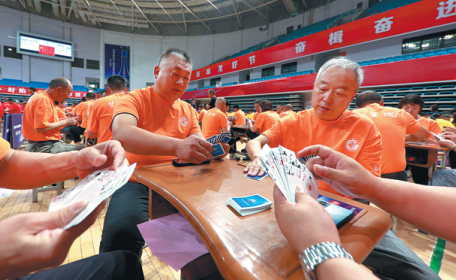
Guandan is played with two decks of cards by four players who form two teams, following specific rules. The players, who sit facing each other, try to defeat the opponent pair by playing out all their cards before the opponents can. The game is strategically based on poker hands such as straights, full houses, pairs or single cards.
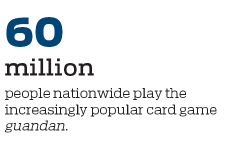
Lan Guowei, deputy secretary-general of Jiangsu Province Guandan Sports Association, claims the game is played by over 60 million people in China. This surge in popularity can be credited to the enthusiastic promotion of the game by local governments and avid card players.
The eclectic band of guandan fans comprises individuals from various sectors, including finance, government, military and academia, he said.
"The game's attraction lies in its competitive nature and simplicity of rules. The thrill heightens as the game progresses and various tactical skills come into play. Success in the game is measured not just by skills and cooperation but an element of luck as well."
Jin Kuang, a researcher from Huaian Guandan Association, said that official guandan competitions have been held in the city since the 1980s, and attributes the game's national popularity to the locals who introduced the game to different regions.
"As an effective social tool, it bridges the gap between various cultural backgrounds and intellectual levels, allowing everyone to unite at the card table," he said.
"Guandan, a popular card game in China's economically vibrant Yangtze River Delta, is spreading to new regions with the area's frequent financial activities," said Zhu Yan, who works for a listed company in Wuxi, Jiangsu.
Zhu notes that guandan, unlike the poker variant Texas Hold'em, is better for social bonding, often played as it is over tea before dinner.
Signs of its popularity in the finance industry are evident. The Jiangsu Financial Industry Association organized a guandan competition in August, which saw wide participation by financial professionals in the city of Zhenjiang. Similarly, the China Development Bank had an online guandan competition for its employees in May. Suzhou Financial Union's April competition attracted players from 64 financial institutions.
While the players try to socialize and strengthen connections at the guandan tables, many elderly people spend their days watching others play the game on TV or online.
Zhang Yang, who lives in Nanjing, Jiangsu, worries about her mother's health as the 71-year-old tends to watch guandan competitions on TV from afternoon to midnight.
"What concerns me is that she is too obsessed with the game. The uncertainty and competitiveness of the game impacts her blood pressure," Zhang said. However, she encourages her mother to play poker with her friends as a way to spend leisure time and improve the agility of her brain.
Meanwhile, authorities are trying to make guandan, sometimes dubbed "Chinese bridge", into a more formal sport.
On Saturday, Hainan province held its first competitive guandan training camp and more than 70 managers of the provincial-level guandan clubs participated.
Also in August, Guizhou province established the country's third provincial guandan association — after Jiangsu and Hainan — in its capital Guiyang.
China Qiyuan, a management center in charge of board and card games affiliated with the General Administration of Sport, has officially standardized the game's rules and issued guidelines on holding guandan competitions through separate statements.
The center has organized a series of open guandan tournaments this year, and the game will also be an exhibition event in the upcoming Fifth National Mind Sports Games to be held in Hefei, Anhui province, in late October and early November.
Much has been done and much more is underway to make guandan an official sports activity in China, according to Lan, the deputy secretary-general of Jiangsu Guandan Sports Association.
Liang Shuang in Beijing and Guo Jun in Nanjing contributed to this story.
cangwei@chinadaily.com.cn