Israel rejects calls at UN for cease-fire in Gaza









UNITED NATIONS/GAZA/JERUSALEM — Israel vowed again to destroy Hamas and rejected calls for a cease-fire from the UN chief, the Palestinians and many countries at a high-level UN meeting on Tuesday.
Israel's Foreign Minister Eli Cohen also dismissed calls for "proportionality" in the country's response to Hamas' surprise attacks on Israel on Oct 7 that killed 1,400 people and has since led to more than 6,500 Palestinian deaths in Gaza.
Cohen urged the world to "stand united behind Israel to defeat Hamas".
Palestinian Foreign Minister Riyad al-Maliki demanded an end to the Israeli attacks.
"We are here today to stop the killing, to stop … the ongoing massacres being deliberately and systematically and savagely perpetrated by Israel, the occupying power, against the Palestinian civilian population," he said. "Over 2 million Palestinians are on a survival mission every day, every night."
UN Secretary-General Antonio Guterres opened the monthly meeting on the decades-old Palestine-Israel conflict — which has turned into a major event with ministers from the conflict's key parties and a dozen other countries flying to New York — warning that "the situation in the Middle East is growing more dire by the hour".
"It is important to also recognize the attacks by Hamas did not happen in a vacuum," Guterres said.
"The grievances of the Palestinian people cannot justify the appalling attacks by Hamas. And those appalling attacks cannot justify the collective punishment of the Palestinian people," he said.
Zhang Jun, China's permanent representative to the United Nations, called for "a comprehensive ceasefire" between Palestine and Israel.
Zhang emphasized that preventing a greater humanitarian catastrophe must be the top priority among all ongoing efforts.
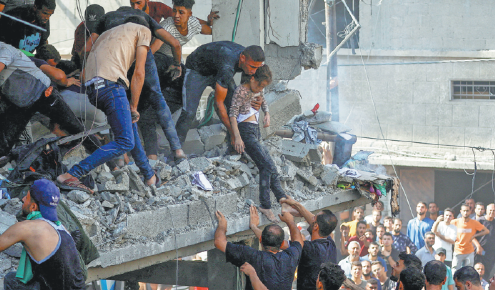
As the Security Council met, a barrage of Israeli airstrikes across the Gaza Strip crushed multiple residential buildings and buried families under rubble. Nearly 90 countries were on the speakers list, including about 30 foreign ministers and deputy ministers, many echoing calls for a cease-fire and halt to attacks on Palestinian civilians.
Risk of spreading
Guterres said the risk of the Gaza conflict spreading through the region is increasing as societies splinter and tensions threaten to boil over. He appealed to all to "pull back from the brink before the violence claims even more lives and spreads even farther".
Deadly clashes have intensified between the Israeli military and Palestinians in the occupied West Bank, and resurged between Israel and Lebanon's Hezbollah armed group along the Israeli-Lebanon border, Reuters reported.
Late on Tuesday, eight trucks with water, food and medicine entered Gaza from Egypt. UN agencies said more than 20 times current deliveries were needed for the narrow coastal strip's 2.3 million people.
A Palestinian spokesman said on Tuesday that the Gaza Strip experienced a "total collapse" of the health system due to the power outage and the exhaustion of fuel needed to operate generators in hospitals.
World leaders are seeking to prevent the conflict from spreading.
Russian President Vladimir Putin and Turkish President Recep Tayyip Erdogan reiterated their support for a two-state solution to the Palestine-Israel conflict, during a telephone call on Tuesday. The two sides expressed "deep concern over the growing number of civilian casualties and the catastrophic deterioration of the humanitarian situation in the Gaza Strip", the Kremlin said.
US President Joe Biden and Saudi Arabian Crown Prince Mohammed bin Salman Al Saud spoke over the phone on Tuesday and agreed on broader diplomacy "to maintain stability across the region and prevent the conflict from expanding", the White House said.
Israeli Finance Minister Bezalel Smotrich put the direct cost of the conflict at around 1 billion shekels ($246 million) a day to Israel, Reuters reported on Wednesday.
Agencies, Minlu Zhang in New York and Xinhua contributed to this story.