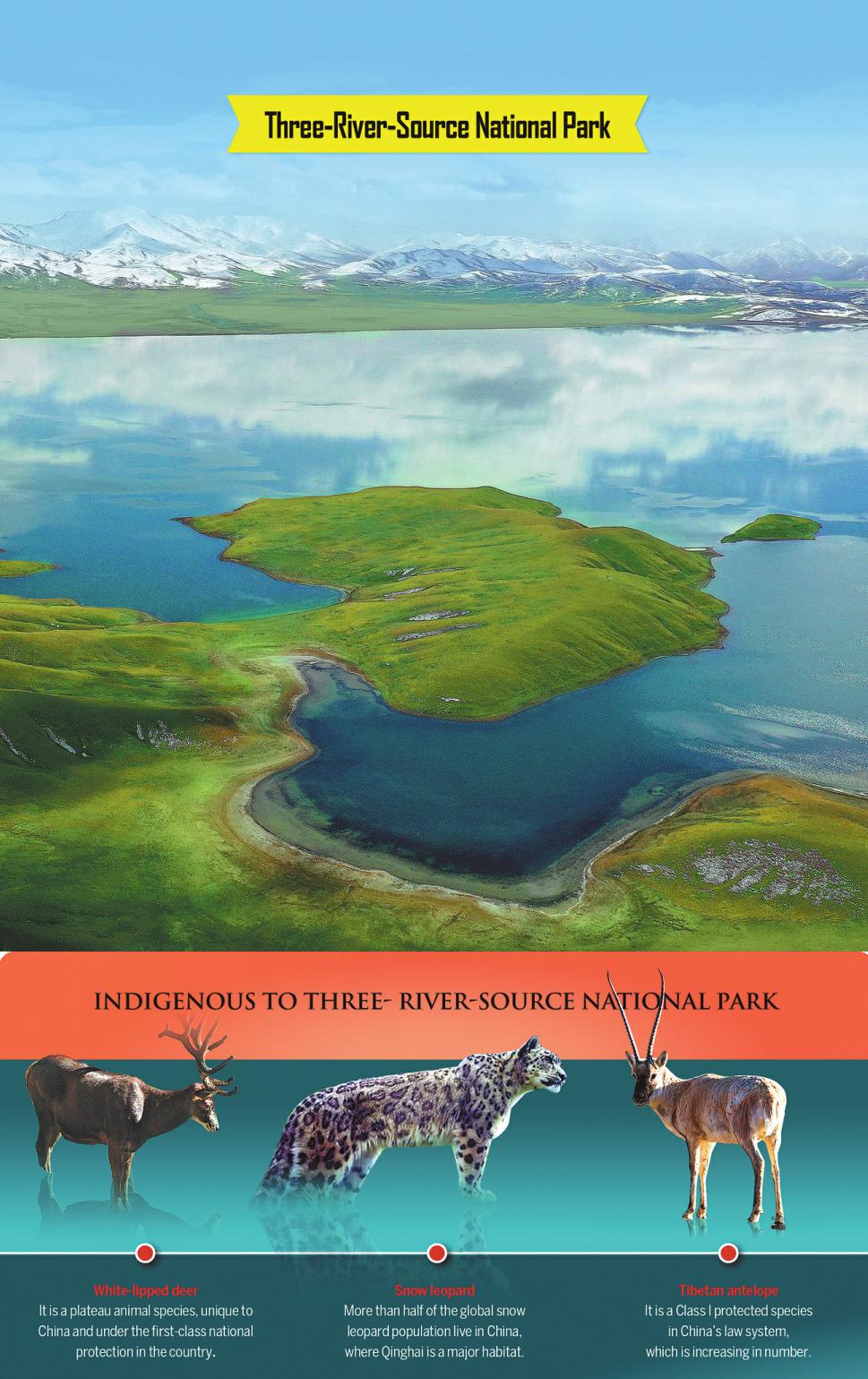
Three rivers' source area whets appetite for ecological conservation









The Three-River-Source National Park, covering 190,700 square kilometers, is China's largest such facility. It is about 21 times the area of Yellowstone National Park in the United States and 28.7 times larger than the Banff National Park in Canada.
Standing at an average altitude of more than 4,700 meters, the sparsely populated park in Qinghai province is the ideal habitat for many wildlife species, including Tibetan antelopes and snow leopards.
Dubbed "Asia's water tower", the Sanjiangyuan area where the park is situated is home to the headwaters of the Yangtze, Yellow and Lancang rivers, with the latter being known as the Mekong once it leaves Chinese territory.
Twenty-five percent of the total water volume of the Yangtze River, 49 percent of the Yellow River and 17 percent of the Lancang River come from the Sanjiangyuan area, with tributaries providing the rest.
Decades ago, climate change and human activity caused serious environmental degradation in Sanjiangyuan, which resulted in a large number of lakes drying out and wildlife numbers falling sharply.
In 2016, the pilot program for the Three-River-Source National Park management system was launched, and the area was officially designated as a national park in October 2021. Through painstaking practice, development and innovation, efforts have been made to turn the park into a symbol of the progress of China's ecological civilization, a model for the protection of the country's important environmental security barrier and a pure land for future generations.
Historic changes
The environment of the Qinghai-Tibet Plateau has undergone comprehensive, watershed changes, according to experts. Through the implementation of environmental monitoring and a geographical information system, the integration of advanced monitoring techniques, the use of communications and information technology, the local authority has realized the high-density, multifactor, all-weather and automatic collection of all kinds of data such as those related to the environment, the ecosystem and resources in the Sanjiangyuan area.
Over the past decade, water conservation in the area has risen by 6 percent every year, and the area has provided 60 billion cubic meters of fresh water per annum to lower-lying regions. Moreover, grassland coverage and grass cultivation have risen by more than 11 percent and 30 percent respectively, compared with 10 years ago.
Tongde, a member of the Tibetan ethnic group, is an environmental protector and ranger in Madoi county in Qinghai's Golog Tibetan autonomous prefecture, where the Yellow River rises. The county is home to more than 3,000 rangers like Tongde.
In a report by Guangming Daily, Tongde, said he is responsible for protecting the grassland, lakes and wild animals, clearing garbage and other pollutants, and recording the lake's environmental condition.
He said he also explains the importance of environmental protection to tourists, adding that the lake is so beautiful that anyone who has visited would want to protect it.
Sun Lijun, deputy director of the Three-River-Source National Park administration, said more than 20,000 local residents have become rangers and protectors in the area as part of a policy aimed at finding at least one job for each household.
The government provides each ranger with an annual stipend of 21,600 yuan ($3,100), while more than 22 billion yuan has been invested in environmental restoration projects in the area, he added.
Local residents enjoy the gifts given by nature, and the establishment of the national park has enabled local herders to transition from exploiting nature to becoming its protectors and benefiting from it, Sun said.
Tashi Dondrub, a local official, said that when the residents realize that their hometown is a place people want to visit and they can make money from the good environment and ecosystem, the idea of harmony between humanity and nature takes root in their minds.
Chen Ruifeng, then member of the Standing Committee of the Qinghai Provincial Committee of the Communist Party of China, said environmental protection is strategically important to Qinghai. The province has made efforts to protect the animals, plants, water and mountains on the Qinghai-Tibet Plateau, and the environment has seen historic, comprehensive and watershed changes, he told a recent news conference.