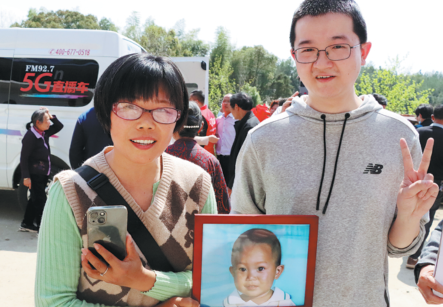
AI assists in finding missing loved ones









A team of students at Huazhong University of Science and Technology in Hubei province is reuniting families with lost loved ones through the use of artificial intelligence technology.
The 30-strong team has developed an AI system that restores old photographs so that they can be better used to identify missing persons.
In the past three years since the team started using this system, thousands of photos have been restored and 11 missing persons have been reunited with their families.
Sheng Jianzhong, a 26-year-old AI engineer who leads the team in Wuhan, Hubei, said he finds great meaning and satisfaction from these efforts, even if the children are unaware of the assistance provided.
The journey began in March 2020, when Sheng stumbled upon a message about a local family searching for their lost child, but the photos provided by the family were too blurry and of poor quality to be of any practical use.
"These kinds of portraits and photos may not be recognizable even if the child is around," said Sheng.
Recognizing the limitations of such images, he decided to apply his knowledge of digital image processing to restore the photos of lost children.
Utilizing AI image restoration technology, Sheng and his team restored the facial features of the missing children and assisted police in conducting facial comparisons with their photo library.
This process has helped narrow potential matches by identifying groups with similar facial features.
DNA testing and verification were then carried out on a small scale to further confirm the identity of the missing children.
Sheng highlighted the challenges of traditional DNA investigation and family relationship models, such as their difficulty in verification, the extensive workload and the wide dissemination of information about lost children.
In contrast, "AI image restoration technology can get twice the results", he said.
Recognizing the need for a massive database to develop image restoration algorithms, Sheng enlisted the help of fellow students who contributed by writing codes and testing the algorithm.
After more than six months of dedicated research and development, the team successfully developed an AI algorithm for image restoration, which addresses the core problem of unclear faces in photos.
The team also contacted relevant government departments, including public security, civil affairs, public welfare and related organizations to expand cooperation and improve the accuracy of technical investigation to help locate the missing children.
Meanwhile, they made clear photos and portraits into adhesive tapes and used them on express delivery packages, while also designing and producing postcards and short videos to facilitate the spread of information about the missing children.
Sheng and his team members have restored images of more than 1,000 missing persons in the past three years.
However, Sheng and his team members rarely have direct contact with the family members, and some may not even be aware of the team's existence.
"Now more and more people from outside Hubei are coming to seek our help, and we are willing to cooperate with the police and provide free services to help restore the images of missing children for them," he said.
Sheng said that his team would continue to spare no effort to improve their technologies and expand cooperation with the police and relevant departments and organizations to help find more missing persons.
A Hubei resident, surnamed Song, said his family thanked Sheng and his team very much.
Song's brother, who had been missing for three decades, was recently found with the help of Sheng's AI image restoration technology.
"Sheng and his team's use of advanced technology to find lost persons is enabling more families to gain new hope for future family reunions," said Song.
Contact the writers at zhengcaixiong@chinadaily.com.cn