Cultural assets proving popular with the public









For residents in Beijing's Tongzhou district, a popular way to enjoy weekends is to visit the subcenter's three new cultural landmarks: the Beijing Performing Arts Center, the Grand Canal Museum of Beijing and the Beijing Library.
All three cultural facilities opened to the public on Dec 27. These buildings represent significant achievements in the transfer of Beijing's non-capital functions and the coordinated development of Beijing, Tianjin and Hebei province, Hu Jiulong, deputy director of Beijing's subcenter management committee, said at the opening ceremony.
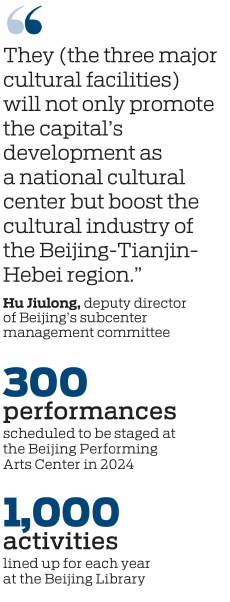
"They will not only promote the capital's development as a national cultural center but boost the cultural industry of the Beijing-Tianjin-Hebei region," Hu said.
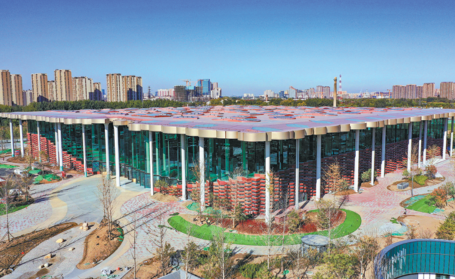
The Beijing Performing Arts Center, located at the Central Green Forest Park, epitomizes the fusion of modern aesthetics with traditional Chinese architectural elements. Its design is inspired by ancient grain silos and ship transportation in the district, earning it the moniker of the "cultural granary".
With a floor area of 125,000 square meters, the center has four indoor theaters — an opera house, a concert hall, a drama theater and a small theater — and one outdoor amphitheater.
The opera house is equipped with one of the country's largest immersive sound reinforcement systems. Meanwhile, the concert hall has been tested twice by industrial experts to ensure top sound quality, according to Sun Hui from the center's operation and management department.
This year, the center is scheduled to stage about 300 performances. These include some signature shows from the National Centre for the Performing Arts, which is the operator of the center, according to staff members.
Additionally, the center plans to introduce some modern art forms such as immersive performances, contemporary dance and experimental theater shows, and host various art-related activities such as workshops to attract the younger generation, staff members said.
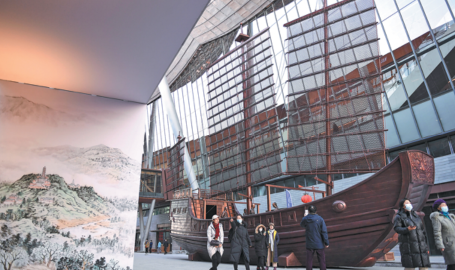
Not far from the arts center lies the Grand Canal Museum of Beijing, which serves as the eastern branch of the Capital Museum of China in the city.
The new museum, consisting of two buildings, draws inspiration from ancient canals, ships and sails in its design: the roof of the sharing hall is shaped like a boat and the exhibition building's roof resembles a sail.
"Not only the exterior design, its displays and exhibits follow the main thread of "people, water and city" to showcase Beijing's history and construction achievements and its mutually beneficial relationships with the Grand Canal," said Tan Xiaoling, deputy curator of the Capital Museum.
To better protect cultural relics, the museum has set up an 18,000-sq-m seismic isolation layer beneath the exhibition building.
There are 242 seismic isolators made of rubber and other materials in the layer, which can minimize damage to relics during earthquakes by blocking the spread of seismic waves, said Zhao Yazhuo from the exhibition department of the Capital Museum. The layer can also help resist moisture, Zhao added.
The exhibition building also includes classrooms and experience centers, while the sharing hall features a canal-themed dining bar, a post office, an activity zone and a four-dimensional multimedia room to offer visitors a well-rounded service, according to the museum.
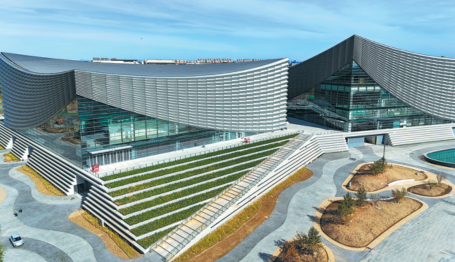
The Beijing Library, capable of housing a collection of 8 million books, features the country's largest intelligent stacks, which can sort and move books automatically, as well as several artificial intelligence-powered robot librarians, said Xie Peng, deputy curator of the library.
These robots tour the library and help readers borrow and return books, Xie said, adding that they can answer inquiries and recommend books to visitors.
According to Xie, the library plans to hold about 1,000 activities every year including exhibitions, lectures, performances and craft workshops to promote reading among the public.
zhanglinwan@chinadaily.com.cn