All about Khon









Striving for the spectacular in Thailand's dramatic arts, Yang Wanli reports in Bangkok.
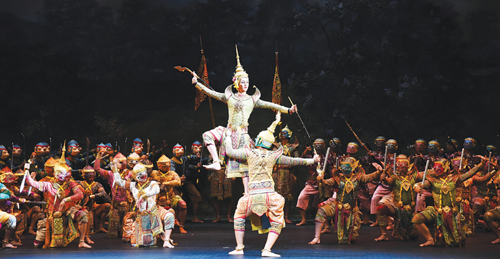
Among all forms of Thailand theatrical arts, Khon is considered to be the highest form that no other dance and theater can match its scale and complexity. "If you are a performing art fan, Khon will definitely the choice that cannot be missed in Thailand," said Admiral Sumpao Polathorn, superintendent of the Khon Learning Center.
The center in Ayutthaya Province, is a place to conserve and demonstrate this traditional Thai masked dance, which was originated at the Ayutthaya period (1350-1767) and combines musical, vocal, literary, dance, ritual and handicraft elements.
The performance depicts the story of Ramakien, a Thai epic based on the Hindu tale of Ramayana. It tells the glory of Rama, the hero and incarnation of the god Vishnu, who brings order and justice to the world.
Admiral said there are many episodes depict Rama's life, including his journey in the forest, his army of monkeys, and his fights with the army of Thosakan, king of the giants.
In the performance, actors are divided into four categories, namely phra (lords), nang (ladies), yak (ogres), and ling (monkeys).
"In ancient times, all actors were required to wear masks. But in modern performance, Only performers of the yak and ling categories still adorn the elaborate masks. Phras and nangs now wear a stylized form of makeup influenced by Thai mural paintings," Admiral explained.
In many ways, he said the Khon performances of the past were more like a mimed show, as actors could not speak through the masks and the graceful body language was full of meanings and emotions.
Each character group possesses their own style of choreography — phra is regal, nang is graceful, yak is powerful, and ling is energetic, he said. As such, dancers are assigned character types early on in their training based on physique and motor skills.
The performing skill of Khon takes several years to master, according to assistant professor Anucha Thirakanont, who is also Dean of the Faculty of Fine and Applied Arts at Thammasat University.
He said professional training starts at a very young age at about 12. Performers can only trail on stage after practice for at least five or six years.
"The actors' bodies must be conditioned like that of gymnasts and the key to executing good moves are flexibility, strength, and attention to details. Once a learner choose to study the performance of one character from the four catalogs, he or she cannot change to others," Anucha said.
He explained that the four character groups have unique art expression for different emotions. "An audience who is well-versed in reading Khon gestures can tell what the characters are saying even without having to hear the dialogues," he added.
Wongsamat Laoprasert, 29, who had learned Khon performance since 12 years old, said he love the art from the childhood. "Now, I am a teacher of those young actors and I feel so proud of passing this Thai cultural essence from generation to generation," he said.
Beyond music and dance
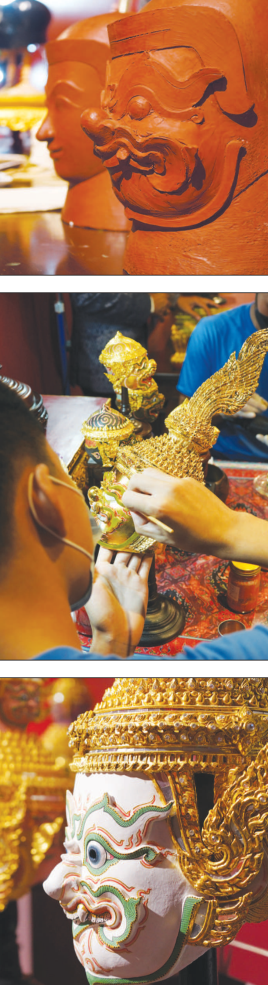
The most unique features of Khon are the exquisite masks the performers adorn. The masks depict the four main categories of characters and also deities, hermits, beasts, and other beings.
There are more than 100 types of demon masks and 40 types of monkey masks for the ensemble cast, according to Anucha. Each mask is different in shape, color, and details, depending on the character's physical description, rank, status, and personality.
"The masks are produced by craftsmen who must be knowledgeable in many disciplines of traditional craftsmanship. It takes more than two months to finish a mask," Anucha said.
Average weight of a single mask is about 1 to 2 kilograms. For actors who play the role of monkey, he said it is even harder to wear a mask during more than one hour performance because they need to bite a string to prevent the mask from falling down.
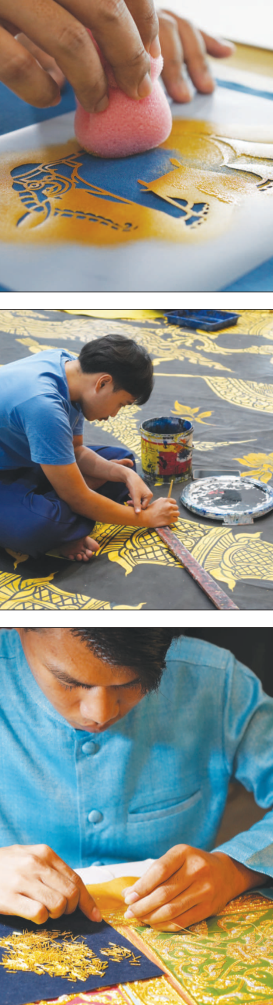
Despite the exquisite Khon masks, equally notable in the performance also include jewelries and embroidered costumes, both require the highest skills in craftsmanship to create. The elaborate costumes are color-coded to symbolize different types of characters and the fabric used to create the costumes is a specialized type of silk with silver and gold brocade.
After that, the fabric is embroidered with metallic threads and glimmering ornaments, which will be taken by artists who are skilled in stitching. Once the clothing is on, actors adorn themselves with jewelries.
"Each character possesses his or her own set of decorations, which are crafted by master goldsmiths and silversmiths. The way the clothes are wrapped and the intricacy of the jewelries indicate the ranks and statuses of the characters," Anucha added.
Look into the future
Being eclipsed by Western-style entertainment, Khon was on the edge of extinction after the World War II. The efforts to revive Khon began under the support of Her Majesty Queen Sirikit, who once famously remarked that "If no one will watch Khon, then I will watch it myself."
"The queen began to regularly stage performances not only for royal guests but also the general public," said Admiral. "Under Her Majesty's SUPPORT Foundation, students were granted scholarships to study various disciplines of craftsmanship, many of which are involved in the process of costume making."
Through Queen Sirikit's efforts, Khon became a thriving national heritage and source of pride for all Thai people. In 2018, the performance was inscribed on the representative list of Intangible Cultural Heritage of Humanity by the UNESCO.
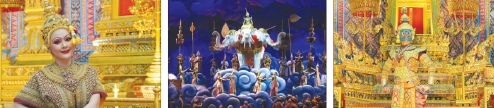
"In order to attract more people to appreciate the performance, the performance will have new content, fresh characters with different costumes being added every year. Also, some modern technologies have been introduced to improve the viewing experience, such as the movable stage props and lighting," said Anucha.
He introduced that the annual Royal Khon last year was in the episode of Kumphakan Blocking the River, which was staged at Thailand Cultural Center for one month starting from Nov 5. "This time, audiences had seen new chapters in the stories and 30 percent of costumes were also newly designed. Moreover, the backdrops were new too," he added.
Recalling a decade ago when the SUPPORT Foundation staged its debut Khon performance in 2007 with few people appreciating this traditional theatrical art, he said more young people are now interesting in inheriting the art.
The performing group under the learning center conducts audition every November for recruiting new performers in 19 Thai dancing schools. In 2022, there were nearly 900 students who participated.
"In 2022, the group performed a total of 50 shows across the country, which is impressive and encouraging, as we knew that more people begins to enjoy the beauties of this traditional Thai performing art and the cultural treasure of our nation," Anucha said.