China's capital a center of global sci-tech innovation









Beijing policies foster massive growth in scientific research and AI sector
Beijing, serving as a vanguard to build China into a world power of science and technology, has always adhered to innovation-driven development and made efforts to shape the advantages of sci-tech innovation, local officials said.
According to a recent news release held in the Chinese capital, Beijing has elevated itself from a national innovation center to a key hub of global sci-tech innovation in the past decade.
Compared with 2014, the city has achieved significant progress in six main innovation indicators, said Yu Yingjie, Party secretary of the Beijing Municipal Education Commission.
Its ownership of invention patents per 10,000 people, for example, has more than quadrupled in the past 10 years, going from 48.2 to 262.9 in 2023.
The annual turnover of technological contracts has more than doubled, increasing from 313.6 billion yuan ($43.3 billion) to 853.7 billion yuan in 2023.
Also, the number of State-level high-tech enterprises in the city; the daily number of newly registered sci-tech companies; the total income of enterprises in Zhongguancun demonstration zone and the added value of high-tech industries have all more than doubled during the past 10 years.
Moreover, Beijing has topped the list of "Nature Index — Science Cities" for years, ranking among the most innovative cities in the world, according to Springer Nature Group, an internationally renowned science and technology publishing institution.
The city also had the largest number of highly cited researchers and academics in the world, according to the 2023 list revealed by global analytical firm Clarivate Analytics.
Among the world's international sci-tech innovation centers, Beijing's ranking has steadily improved in recent years. It took third place worldwide in 2022 and 2023, according to the Global Innovation Hubs Index released by Springer Nature and Tsinghua University.
Aimed at the forefront of technological development, Beijing has strengthened basic research and made breakthroughs in original innovation.
Currently, the city is home to 77 key national laboratories, accounting for 28.1 percent of the country's total. The construction of Huairou Science City, which serves as a comprehensive national science center, is making steady progress, with 16 of its 29 facilities and platforms put into use.
Another highlight is the high-quality development of eight new research and development institutions, including the Beijing academies of quantum information sciences and artificial intelligence.
Other efforts that Beijing has made include accelerating the implementation of an action plan for developing key and core technologies, and making R&D breakthroughs in such sectors as AI, quantum information, integrated circuits and key new materials.
The initiative has resulted in a number of major innovations, like the new generation of quantum computing cloud platforms and the world's first methane-fueled liquid rocket to complete an orbital mission.
Among the projects in the Top 10 lists of Scientific Advances in China released from 2012-22 by the Ministry of Science and Technology, 56 were led by the Beijing sci-tech units, accounting for 51 percent of the total.
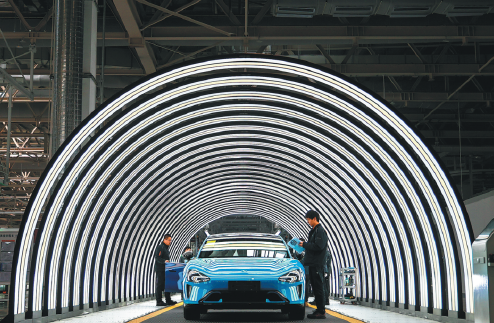
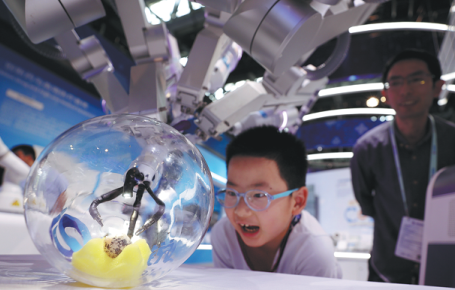
Beijing attaches great importance to promoting new quality productive forces. It has issued more than 30 policies to support segmented industries, including general AI, humanoid robots and commercial aerospace.
It has so far cultivated two trillion-yuan industrial clusters of new-generation information technology and sci-tech services, and eight 100-billion-yuan industrial clusters.
In 2023, the city's innovative industrial cluster demonstration zone, which mainly refers to Beijing Economic-Technological Development Zone and Shunyi district, undertook more than 270 research achievements from the Zhongguancun, Huairou and future science cities.
This year, Beijing will focus on implementing industrial policies in AI, commercial aerospace, the low-altitude economy and other fields, and accelerate the development of advanced and sophisticated industries such as 6G, quantum information and synthetic biological manufacturing, said the Zhongguancun management committee.
It will also continue to construct a global digital economy benchmark city. In 2023, the city's added value of the digital economy accounted for 42.9 percent of its GDP, the committee added.
haonan@chinadaily.com.cn