THE FINE PRINT









Independent, physical bookstores find their niche amid digital trends, other challenges, Cai Hong reports.
In central Beijing, where property prices and rental costs are known for hitting astronomical levels, an independent bookstore is making waves for persisting with what may seem like an improbable business model — poetry.
Peng Mingbang, founder of the bookstore Poetic Books, said he is certainly often asked whether people still write and read poems.
"Being a poet is really an otherworldly interest. Few people can make a living by writing poems," Peng said.
Most of the poets he deals with come from all walks of life, such as farmers, miners, security guards, deliverymen, police officers, public servants and businesspeople.
In May 2017, Peng decided to resign from a publishing group where he had worked as an editor for 23 years. His bookstore opened in June that year, when he was 53.
Seven years on, Peng continues to sell poetry books. He also published 250 kinds of poetry-related books, including the Good Chinese Poems series.
"Poetic Books has turned out to be a meeting place for poets and writers to chat. New poetry book launch events are often held here," Peng said.
"It may be a bookshop with the best artistic vibe in Beijing," said frequent visitor Duan Shihan.
In December 2019, Peng opened a second bookstore, Niche Bookstore, close to the Temple of Earth in the northern part of central Beijing. Thanks to his connections in the publishing world, the store sells signed books by major authors ranging from female poetry sensation Yu Xiuhua to sociologist and sexologist Li Yinhe. Novelist Li Er, best known for his book Brother Ying Wu that won the 10th Mao Dun Literature Prize in 2019, signed books at Niche Bookstore a dozen times a year.
Awarded every four years since 1982, the Mao Dun Literature Prize for novels, established in the will of prominent Chinese writer Mao Dun and sponsored by the China Writers Association, is one of the most prestigious literature prizes in China.
"Opening a bookstore can become an addiction," Peng said.
He co-opened, with a friend, a third bookshop in May 2021. This one, however, did not last long, going out of business in less than a year. Peng called a bookstore a small business, recommending that those who are interested in running bookstores not crave for commercial success in a hurry.
To manage the prices of its books, Niche Bookstore offers direct sales on digital platforms such as JD, Taobao and WeChat.
Still, many other physical bookstores, especially independent ones, are struggling to survive in China.
Cheng Yonghui opened a third bookshop in Hengshui city in the south of Hebei province, focusing on reference books for teachers and students. To make ends meet, he had to reduce the number of employees last year and his plan for a new bookstore in 2024 came to a standstill.
Many industry insiders said the stagnation of China's physical bookshops could be traced to discount sales via livestreaming. But Cheng said publishing houses are responsible for the situation.
Discounts offered by e-commerce platforms are significantly greater and publishers have to raise the prices of books to ensure profits, with a vicious cycle occurring between the two, they said.
Cultural venues
Twenty years ago, Liu Suli, founder of All Sages Bookstore, rang the warning bells that publishing houses would have no right to set prices if books were sold at discounts online.
China's publishers have since raised the prices of books in recent years in an attempt to deal with e-commerce and livestreaming platforms that sell books cheaply.
The main victims of the situation are readers, Liu said, adding that bookstores then try to find their own way of selling items in an approach that is different from traditional e-commerce and large sales.
In 1996, All Sages Bookstore became a trailblazer by selling books online with the help of Zhang Shuxin, founder of Beijing Information Highway Corp, whose website is believed to be the first internet portal in China.
In 1993, the bookstore opened in the northwestern part of Beijing's Third Ring Road. The store was within walking distance of higher learning institutions such as Renmin University of China, Beijing Institute of Technology and Beijing Foreign Studies University.
In 1995, when the Third Ring Road was reconstructed, the All Sages Bookstore found a new location in an alley between Peking University and Tsinghua University, China's top two educational institutions.
Wang Qiang, a graduate of Peking University and co-founder of educational services giant New Oriental Education & Technology Group Inc, is one of the biggest book buyers at the All Sages Bookstore. He frequented the bookshop from 1996, when he returned to Beijing from the United States.
The bookshop paid close attention to social issues by setting aside a special section for topics such as agriculture, farming and rural areas, urbanization and the environment. The topics are what many people in the country, intellectuals in particular, have been concerned about in recent years.
The bookstore had to move again in 2002 when the houses along the alley were demolished. It added new items such as those related to art, literature, audio and video, and business management onto its shelves as its space increased from 80 square meters to 600 square meters. It also expanded from 14,000 genres of books to 45,000.
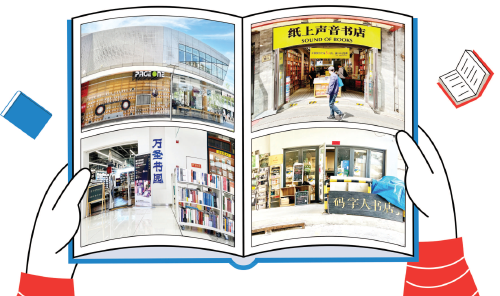
After its latest move into a fancy shopping mall in December, All Sages Bookstore is now more spacious, sandwiched by two clothing shops. An amusement arcade is 10 meters away.
Wherever All Sages Bookstore moves, its loyal customers follow. The bookstore has become an influential gathering place for intellectuals. This cultural hub is to Beijing what Shakespeare and Company is to Paris and City Lights bookstore is to New York, according to its fans. The store, which stocks books about humanities and social sciences, is also believed to be a barometer of China's contemporary academic thinking.
Riding trends
As independent bookstores find it more difficult to sell new books, some of them have figured out that discounts work.
Insight Books, located between the 798 Art Zone and 751 Design Park in northeast Beijing, started putting its books on sale in 2022. Wu Min, founder of the beautifully designed bookstore, joined a small group of independent bookstores stocking its inventory from publishing houses.
"The rivals are nevertheless united by the freemasonry of keeping our bookstores alive," Wu said. "The group leader is so kind that he always tries hard to take care of the ones that are unable to get copies when a popular inventory from publishing houses is available."
Wu was assigned to an aerospace research institute in Beijing after graduating from a university in Hefei, Anhui province, in 1995, but left the position two years later. Before opening Insight Books in 2008, she worked at a foreign company and an internet business. She also ran a Western restaurant.
Insight Books is now where Wu finds her passion and where her management skills work well.
Yan Bing, co-founder of bookstore chain Sound of Books, has a huge warehouse in Hebei's Zhuozhou city, a major hub for China's publishing industry. Many publishing companies and bookstores have depots there.
Yan has four branches in different bustling districts of Beijing and aims to expand the number to 10 in the coming years.
Thanks to his large inventory, the Sound of Books chain is able to upgrade its shelves with about 1,000 new kinds of books every day.
"It is a big workload," Yan said. "What is more demanding is that you have to get more stock from publishing houses."
Changing times
According to an annual report on the publishing industry issued by the Publishers Association of China and the Book and Periodicals Distribution Association of China in February, short-video platforms became the second-largest book sales channel in 2023, following e-commerce platforms. Bookstore sales continued a downward trend.
China's retail sales of books totaled 91.2 billion yuan ($12.8 billion) in 2023, up 4.72 percent year-on-year.
The total number of active titles, as gauged by ISBNs in the overall retail market, reached 2.37 million, an increase of 1.55 percent.
The report showed that 180,000 new titles were published in 2023, a rise of 7.3 percent over the previous year.
"It is a mistake to homogenize young people and say they are not reading," Wu of Insight Books said. "Most of the customers visiting my bookstore are young people."
She remains optimistic about physical bookstores and an industry survey on the latest reading habits in China is good news for Wu and the brick-and-mortar bookstores in the country.
Almost half of the adult respondents said they preferred reading printed books to other formats as of February 2023. But reading on mobile phones or e-readers has been attracting more Chinese readers.
Pan Xinze, in his 30s, opened Gateway Bookstore in an old residential district in Benxi city of northeast China's Liaoning province four years ago.
"I want to give those who don't read a chance to start picking up a book, and those who read access to more books," he said. "But that's easier said than done."
Like many industrial cities in Northeast China, Benxi, previously a steel hub, has seen better days. Young people are leaving the city amid an economic slump and ageing population.
But Pan did not expect his bookstore to fare well in the city of 1.32 million — one of the smallest among Liaoning's cities. His venue has become a "spiritual glue" that holds book lovers together, Pan said.
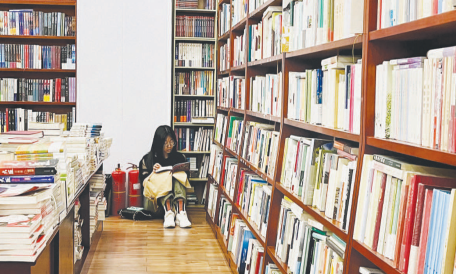
"The local bookworms usually come to the store every other day to grab a book or a cup of coffee, and those who live in other parts of the country visit the store every time when they return," Pan said.
During the pandemic, when many small bookshops could hardly make ends meet, Pan's store saw bustling business. Many Benxi residents who used to live and work at other places returned to the city, marking an increase in customers for Pan's bookstore.
Its bestsellers are the literary books about Northeast China, he said.
It is a far cry from the bookstore's early days, when it raked in just 400 yuan in the first month after it opened for business.
"Seeing the readers, ranging from teenagers to the elderly, enjoying the books they want, is my reason for soldiering on," Pan said.
Contact the writer at caihong@chinadaily.com.cn