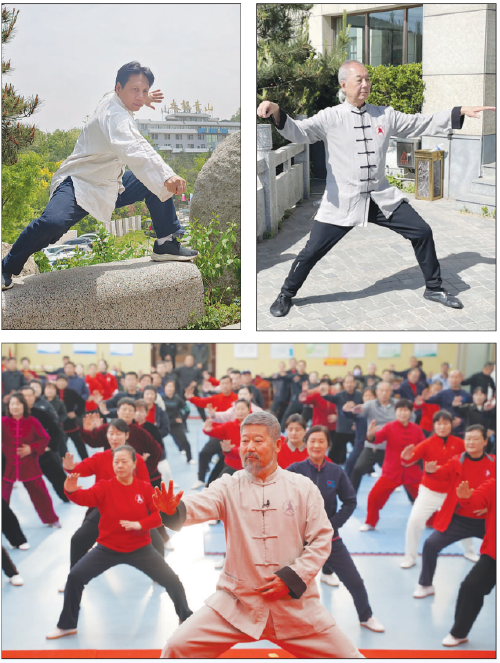
For the love of tai chi









Martial art master promoting Chinese culture worldwide sees birthplace become hub of activity, An Baijie reports in Rizhao, Shandong
When Chen Zhonghua pursued his master's degree at the University of Regina in Canada 39 years ago, he practiced tai chi regularly on the lawn outside the faculty building.
His fluid, steady movements mesmerized many people on campus, signaling the start of a wave of popularity in the West for the Chinese martial art in the decades to follow.
Chen, 63, is now a famous tai chi master, having taught more than 250,000 students and disciples worldwide. His dedication to the promotion of tai chi culture helps fuel growing interest in the art and Chen's birthplace, Wulian county in East China's Shandong province, alone draws many practitioners and adherents to its major tai chi competitions, classes and related events, with the latest international tournament held in early May.
Chen said he had his first tai chi disciple, Art McBeath, a professor at the Canadian university, in 1985.
"When I was practicing tai chi at the campus in the morning, someone said 'hello' to me and I found out he was my professor. He asked whether he could learn tai chi from me and I said 'of course'," Chen said.
He went on to accept more than 60 tai chi followers, mostly professors and staff members at the university, beginning his lifelong journey to help promote Chinese culture.
Master class
Chen suffered from various illnesses during his childhood, making him frail and weak. He could not take part in many sports and tai chi turned out to be one of the few physical exercises he could do.
In 1979, Chen enrolled in the English department of Shandong University. He was known as a diligent student, working hard to improve his English skills. He also began to study martial arts under the guidance of school teachers.
Chen subsequently heard of a local tai chi master, Hong Junsheng, who was a disciple of grandmaster Chen Fake, and he resolved to pit his skills against the elderly practitioner. Hong easily defeated the much younger and physically stronger Chen who, impressed, quickly decided to become a disciple of the master.
In 1985, Chen and his wife went to Canada to pursue their graduate degrees. Chen continued his martial art practice during his studies there, often practicing on campus whenever he had time. His tai chi skills gradually attracted many admirers and he realized the possibility of promoting its culture overseas.
After completing his degree, Chen taught social studies under the Canadian secondary school system in Edmonton, Alberta, where he also continued to teach tai chi part-time.
In 2001, he began teaching tai chi full-time. More people knew about what he was doing after a local journalist published a news report headlined, "Chen is Chen, Smith is Smith".
Chen's influence soon extended beyond Canada. The tai chi master has conducted classes, seminars and workshops in numerous other countries including the United States, Australia, Germany, Italy, the Netherlands, Singapore and Indonesia.
Chen also founded the International Tai Chi Academy after he began to head the overseas promotion of Chen-style tai chi practical techniques in 2004. The academy has grown to include more than 150 branches in over 40 countries and regions, with more than 500 disciples comprising over 30,000 registered overseas.
Cultural connection
Gora Nebulana, 48, is manager and coach of Harmony Wushu Indonesia, a martial arts workshop with more than 50 members including 35 athletes. He said he was shocked after seeing how Chen had defeated every challenger at a workshop in Indonesia in 2013.
"When I tried to push with him, I could do nothing," Nebulana said, recalling his first few martial art moves with Chen at a seminar in Indonesia. "At that time, I was already champion in push hand (a form of tai chi competition) in Indonesia."
Challengers big or small, young or old, faced Chen at the seminar, but all failed, Nebulana said, adding that he became a disciple of Chen in 2018 and started to call him Shifu, or teacher.
"Shifu Chen is very skillful in tai chi, incredibly skillful," he said.
Many people are learning tai chi in Indonesia, Nebulana said, with young practitioners favoring tai chi competitions more and the older ones preferring the qigong meditative exercise style.
Nebulana, who has 40 years of experience in martial arts, said that tai chi is not just a sport but also a kind of philosophy.
"It's not just about looking good, it has some principle and philosophy inside it, which can bring you strength, health and a peaceful mind," he said.
Young tai chi athletes may focus more on the competition but later on they will realize it is beneficial not only for its medals but also for their health, mindset and discipline, Nebulana said.
"It's very useful in life, and that's why I choose the life of tai chi and wushu (martial art). It's a lifelong journey for me," he said, adding that all of his family members are martial art athletes, including several champions at the national level.
John Saw, a 90-year-old Australian disciple of Chen, said that he decided to follow Chen after hearing his open-house lecture in Australia 10 years ago.
"I like his teaching so I try to follow him. I met with a lot of kung fu masters but he was the one that really impressed me," Saw said.
Saw started to learn qigong at the age of 60 after he was diagnosed with a stroke. He had taught qigong in many places including Hawaii, Los Angeles, Spain, Chile and Venezuela.
"My grandmother was from Xiamen of China. She told us a lot about China when we were young. After dinner we sat down and talked about Yue Fei and many other heroes," he said, referring to the Song Dynasty (960-1279) patriot-general.
"And she said, if you learn qigong, you'll live a long life. When I was in hospital, I remembered this, so I started to learn qigong," Saw said.
Learning platform
In 2005, Chen returned to Wulian county and conceived the idea of building a tai chi school in the mountainous Daqingshan area. The school was established a year later with the support of the local government, becoming an important base for tai chi training and competitions.
In 2013, Chen hosted the inaugural International Taijiquan Festival on Daqingshan. The event drew several thousand visitors and competitors, with its success leading to subsequent editions.
On May 9, the 8th Daqingshan Taijiquan Invitational Competition commenced in Wulian. The sports event drew more than 1,000 participants, including athletes from 10 countries and regions including Germany, France, Singapore, Australia and Malaysia, as well as domestic professionals.
Paul Pryce, a Lohan qigong disciple of John Saw from Australia, said that he was captivated by Chen's tai chi skills when they met in 2013, leading him to practice under Chen's guidance and nurturing his love for Chinese traditional culture.
The Australian visitor said it was his third trip to Daqingshan and each time he deepened his fondness for the place. Tai chi, which has significantly enhanced his health, is a treasure for the world, he said.
Zhang Shujuan, head of the Wulian publicity department, said that tai chi culture has flourished in the region, becoming a prominent symbol and calling card of the county.
"We will attract more domestic and international tourists to Wulian for leisure, fitness, sightseeing and investment, driving economic development through the increased passenger flow from the sports events," she said.
Nebulana, the martial arts coach and manager, led a team of five athletes including his daughter, 22-year-old Zeela Nebulani, to attend the recent competition.
"We know China is home to tai chi," he said. "We know it's going to be tough (to compete). We come here not to try to win, but to try to learn."
Contact the writer at anbaijie@chinadaily.com.cn