Energy cooperation goes from strength to strength









China and Kazakhstan have been pioneers in production capacity cooperation, upholding the principles of mutual benefit and win-win outcomes, a Chinese official said.
Chinese Ambassador to Kazakhstan Zhang Xiao said in a recent interview with local media that China-Kazakhstan energy production capacity cooperation sets a commendable example globally. It meets the development needs of both countries with an early start, solid foundation and well-established mechanisms, he added.
One of the most promising fields of cooperation between China and Kazakhstan is new energy, Zhang said. Under the framework of the Belt and Road Initiative, China has launched several high-quality new energy projects in Kazakhstan in recent years.
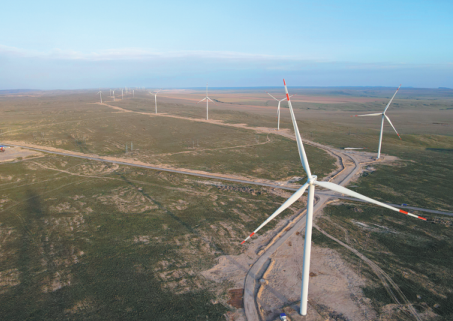
Examples include the Zhanatas wind farm, one of the largest of its kind in Central Asia, Turgusun hydropower station and a wind power project in Akmola. Each provides robust support for Kazakhstan's economic development and low-carbon transition, he said.
The Zhanatas wind farm, invested by China Power International Holding and Kazakhstan-based Visor Capital, consists of 40 wind turbines, each with a capacity of 2.5 megawatts. This makes it the largest wind power project in Central Asia under China-Kazakhstan cooperation.
The project can generate approximately 350 million kilowatt-hours of electricity annually, saving about 110,000 metric tons of standard coal compared to thermal power of the same capacity. The commissioning of this wind farm has strategic importance for improving the imbalance of electricity supply and demand between northern and southern Kazakhstan.
The Turgusun hydropower station, located on the Turgusun River in the Altai district of east Kazakhstan, has a total installed capacity of 24.9 MW and an average annual power generation of 79.8 million kWh. Led by China International Water & Electric Corp, the project began generating electricity in July 2021 and received its temporary completion certificate in April 2022. It has significantly alleviated the shortage of power in east Kazakhstan and reduced local electricity production costs.
Ambassador Zhang said that the new energy industry has advanced production capacity with immense development potential. China is willing to work with Kazakhstan to seize the historical opportunity of the rapid development of the global new energy industry, continuing constructive cooperation in policies, standards and investments, and thereby promoting domestic industrial upgrades and economic development in both countries.
Within the BRI framework, cooperation in the new energy field is not only a reflection of the remarkable achievements in China-Kazakhstan energy collaboration but helps boost Kazakhstan's economic and social development.
One of the four major refineries in Kazakhstan, the Atyrau refinery, financed by the Export-Import Bank of China, has a processing capacity of 5.5 million tons of crude oil per year. It enhances the added value of Kazakhstan's petroleum products and bolsters the development of the country's energy industry.
Another example primarily involves the construction of a new electrolytic aluminum production facility in Pavlodar with an annual capacity of 240,000 tons. The plant is the first electrolytic aluminum plant in Kazakhstan. The project adopted the world's most-advanced electrolytic aluminum technologies at the time and achieved world-class standards in environmental protection, occupational health and construction safety.
For more than 20 years, Chinese enterprises have invested in research and development and industrial deployment in the new energy sector, forming unique advantages through market competition. These advantages include technological innovation, supply chain integration and market ecosystem development.
According to the International Energy Agency's report, China contributed over half of the global increase in renewable energy capacity in 2023, which totaled 510 million kW.
Also in 2023, China's production and sales of new energy vehicles both exceeded 9 million units, maintaining the global lead for nine years. NEV exports reached 1.2 million units, a year-on-year increase of 77.6 percent, making China a force in driving the transformation of the global automotive industry. Electric passenger vehicles, lithium-ion batteries and solar cells, known as the "new three" in foreign trade, achieved exports worth 1.06 trillion yuan($145.6 billion).
China's wind power and photovoltaic products have been exported to more than 200 countries and regions worldwide, helping many developing countries access clean, reliable and affordable energy.