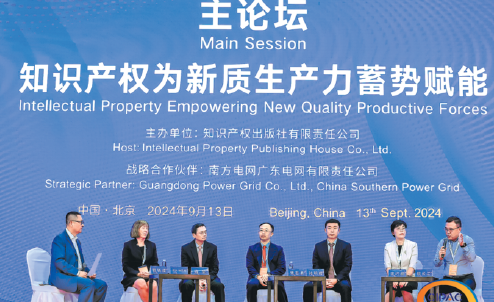
CIPAC key venue for international dialogue









Annual intellectual property conference discusses a wide range of topical issues
To develop new quality productive forces, it is necessary to give full play to the key role of technological innovation in improving productivity and continuously strengthening intellectual property protection, said a senior official on Friday.
Shen Changyu, head of the China National Intellectual Property Administration, made the remarks at the opening of the 13th China Intellectual Property Annual Conference in Beijing.
The two-day event attracted heavyweight guests from home and abroad to exchange insights into topical issues in the sphere of IP. They included government officials and representatives from international organizations, academia and the business community.
Shen called for making full use of IP to better incentivize high-level innovation and ramp up innovation in industries, development models and mechanisms so as to foster momentum to empower new quality productive forces.
Daren Tang, director general of the World Intellectual Property Organization, said the global IP landscape is undergoing a profound shift, with the engines of IP growth increasingly diverse. "China is driving this transformation, leading the world in patent, trademark and design filings."
"This forum provides an opportunity for a rich, multistakeholder conversation on the development of the Chinese and global IP ecosystem, and I am certain that the outcomes of the discussions here will help WIPO and its members build a vibrant, effective and inclusive global IP ecosystem," he added.
Cambodia's Secretary of State of the Ministry of Industry, Science, Technology and Innovation, Phork Sovanrith, also appreciated the annual conference's role in promoting technology transfer and industrial development and assisting in international cooperation in innovation and IP.
Based on a memorandum of understanding signed by the CNIPA and Cambodia's MISTI, Cambodia recognizes patents granted in China.
The bilateral cooperation, which is mutually beneficial and across the board, is the continuation of the long-lasting friendship between the two countries, Phork noted.
Phork said he has faith in the prospects of CNIPA-MISTI cooperation, which is conducive to IP protection and technology transfer and commercialization in both countries.
CEO of the Saudi Authority for Intellectual Property, Abdulaziz Mohammed A Alswailen, stressed the necessity of using emerging technologies such as blockchain and artificial intelligence to increase IP administrators' work efficiency and better address the growing complexity of the digital era, by the advent of rapid technology progress.
To promote cooperation against the backdrop of the global digital economy, IP offices need to transform themselves and change their work style to adapt to the demand of the era, he said.
Huang Hanquan, dean of the Chinese Academy of Macroeconomic Research, suggested scaling up commercialization and industrialization of technological innovation achievements, which helps transform traditional sectors, foster and strengthen emerging industries, and stay ahead of the curve when it comes to developing future industries. That will help to build a modern industrial system and promote the creation of new quality productive forces, he added.
Song Liuping, senior vice-president and chief legal officer of Huawei Technologies and member of the company's supervisory board, suggested looking into the IP system from a global perspective.
The jurisdiction concerning IP, as well as related judgements and verdicts, constitutes a part of the global rules on IP. In this regard, China as the country that boasts the largest trade volume, the second-largest GDP and the largest manufacturing industry worldwide could make a greater contribution, Song said.
Compared with other countries, China has a salient feature in its IP administration. At national, provincial, city and county levels, there are government departments dedicated to IP issues and they are authorized by law to conduct administrative mediation and give rulings.
If the administrative rulings, mediation and protection and judicial protection can work in tandem, it will result in a synergy that can yield high efficiency and swift responses and could make China a key international hub for IP dispute resolution, he noted.