


Protection efforts see Potala Palace thrive









Global importance of site's cultural heritage highlighted through renovation and preservation projects
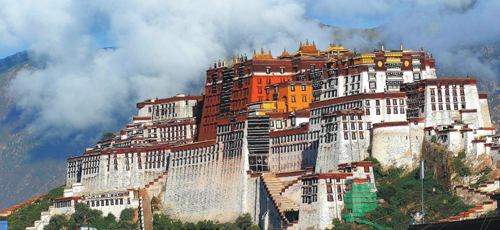
Located on the top of the Red Hill in the northwest of Lhasa, the capital of the Xizang autonomous region, Potala Palace is among the top destinations that tourists around the world aspire to visit, especially since its inscription on the UNESCO World Heritage Sites list in 1994.
The spectacular palace complex is also one of the treasure troves of Chinese culture, as it represents the highest level of ancient Tibetan architectural art and embodies rich historical connotations.
Potala Palace was first built in the era of Songtsen Gampo some 1,300 years ago. Songtsen Gampo established the Tubo Kingdom by uniting the Qinghai-Tibet Plateau in the seventh century, and made Lhasa the capital of the kingdom. Tubo is the more ancient name of Tibet, which is today known by Xizang.
In the process of building a capital city in Lhasa, Songtsen Gampo began construction on Red Hill Palace, the predecessor of Potala Palace. Red Hill Palace was a large palace complex in the very beginning, boasting about 1,000 rooms and halls, according to local historical records.
Red Hill Palace fell into a state of disrepair in the ninth century due to a war that caused the fall of the Tubo Kingdom and a devastating fire caused by a lightning storm.
In 1645, Ngawang Lobsang Gyatso — the fifth Dalai Lama — ordered the reconstruction of a palace complex based on the former Red Hill Palace and the project was completed in 1647. The establishment has been called Potala Palace since then.
After many renovations and expansions in the years that followed, the palace complex gradually took on its current appearance, with the White Palace and Red Palace as its main structures.
Potala Palace is situated on the slope of the Red Hill, with its highest part reaching an altitude of more than 3,700 meters. With a total length of about 360 meters and a width of about 140 meters, the palace complex now covers a land area of 360,000 square meters and has a combined floor space of 130,000 sq m. The central part is a huge, 13-story structure called the White Palace, while the two wings, both having seven stories, are collectively called the Red Palace.
Potala Palace is a treasure trove of ethnic culture with its collection of many precious historical and cultural relics.
Its precious collections include eight golden pagodas to memorize the past generations of Dalai Lama, five exquisitely decorated altars, and more than 60,000 ancient documents to record the achievements in culture, art, religions and science created by people of various ethnicities that include Tibetan, Han, Manchu and Mongolian.
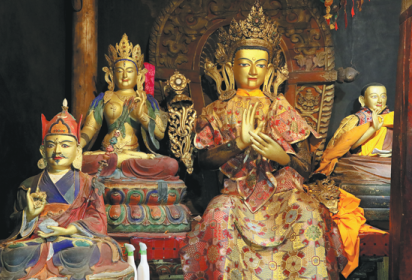
It also boasts more than 100,000 historical and cultural relic items that fall in the categories of porcelain, gold ware, silverware, Buddhist statues, murals, thangka paintings, garments and ornaments.
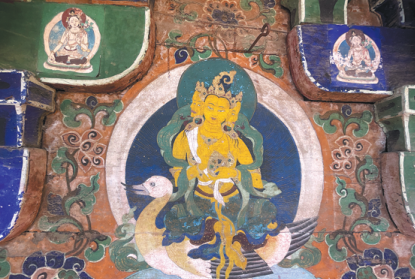
It is also of note that Potala Palace is virtually "a museum of wall paintings", which feature the ancient Tibetan characteristics of drawing with smooth lines, highlighting details and presenting a rich variety of topics.
In 1961, Potala Palace was included on the State Council's list of the first batch of national-level units for cultural heritage protection. In 1994, it was inscribed on the list of UNESCO World Heritage Sites.
Since the peaceful liberation of Xizang in 1951, the central authorities of China have attached great importance to the protection of cultural heritage in Potala Palace, investing huge sums of money into the repair, renovation and preservation of cultural relics.
Over the past decades, especially after its inscription on the World Heritage Sites list, Potala Palace has garnered great attention at home and abroad, by attracting tourists and exhibiting its cultural relics to the public.
Many cultural heritage experts and relics protection workers in Xizang have devoted great energy to the preservation of the precious cultural assets at Potala Palace, making it a shining pearl of Chinese culture.
Kunga Tashi, deputy director at the management office of Potala Palace, for instance, is a renowned local cultural researcher and an experienced expert in cultural relics protection.
He is among those who are most familiar with the history, present status and future prospects of Potala Palace.
"Since it was originally built by King Songtsen Gampo of the Tubo Kingdom in the seventh century, the entire construction history spans 13 centuries," Kunga Tashi said.
He said the only remaining buildings from the seventh century are the King Songtsen Gampo Cave and the Holy Avalokitesvara Chapel.
"The architectural structures and cultural relics of different periods reflect the political, economic and cultural exchanges and integration among various ethnic groups of China." Kunga Tashi said. "Especially during the reconstruction of the Potala Palace by the Fifth Dalai Lama in the 17th century, artisans from Tibetan, Han and other ethnic groups participated in the reconstruction."
Dawa Ngodrub, an official in charge of renovation at the Potala Palace management office, said that one important reason behind the successful preservation of cultural relics in Potala Palace is the strong support from the central and local governments, especially in terms of repair and renovation.
"Since the founding of the People's Republic of China, Potala Palace has had several large-scale repairs," Dawa Ngodrub said.
She said the first repairs were made from 1989 to 1994, mainly targeting the prevention of security risks within the palace.
The second phase of repairs took place between 2002 and 2009, with a total investment of more than 200 million yuan ($28.3 million). The money mainly covered the repair of the palace's body and sleeper walls, restoration of its murals and environmental improvements in its Shol Courtyard, according to Dawa Ngodrub.
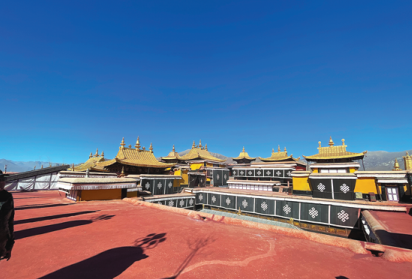
In recent years, she added that the palace has received high attention from the nation's relics protection experts. Repairing the seven golden roofs was among the major tasks during the period.
The renovation of the Shol Courtyard's surrounding buildings started in 2018, with a total investment of 31 million yuan.
"We believe the government will continue to play a big role in the preservation of the whole of Potala Palace in the future," Dawa Ngodrub said. "We need to use new technologies to enhance our preservation efforts, making them more rational and effective."
Lhundrub, another official at the Potala Palace management office, also highlighted the use of new technologies and new management models in the operation and protection of Potala Palace.
"We are using a new management model for tourist reception at the Potala Palace that includes systems for ticket reservation and visitor flow control," Lhundrub said.
"Since Potala Palace is a complex of Tibetan civil structures more than 1,300 years old, the carrying capacity of the buildings is limited," Lhundrub said. "To better protect the palace, we have implemented a crowd-diversion practice. Security personnel are tasked to divert crowds to the right places at any time based on monitoring videos and analyzing the detected structural load data."
Potala Palace has a collection of a large number of palm-leaf scriptures, which are some of the most precious documents in Buddhist culture.
Pema Dekyi, an ancient scripture restoration specialist at Potala Palace, explained how these valuable cultural assets are protected.
"Palm-leaf scriptures are mainly Buddhist sutras written or engraved on pattra leaves," Pema Dekyi said. "They are precious ancient literature and are among the cultural relics enjoying the highest level of protection in China."
He added that China currently has the largest number of preserved palm-leaf scriptures in the world, and Potala Palace has some of the most precious copies.
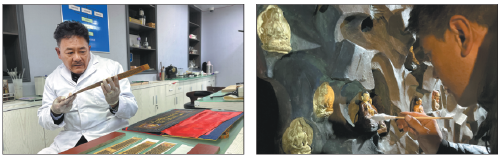
The Potala Palace management office created an experimental restoration team for palm-leaf scriptures in 2019. Its main purpose is to overcome the difficulties arising in repair and restoration, according to Pema Dekyi.
He said that, at present, there is no mature experience or technology in the world to draw upon for palm-leaf scripture restoration. That's why Potala Palace set up this special team, which has been carrying out experiments for nearly five years.
The official showed photos of a copy of palm-leaf scripture before and after restoration, explaining that "after many years of wear and tear, the common issues for the scripture copies are fiber delamination, warping and wrinkles, as well as fractures and contamination".
Pema Dekyi called these problems "leaf diseases", saying that "treating the leaves' diseases needs both a holistic approach and solutions on a case-by-case basis".
"We have to assess the situation of each disease and select the appropriate repair method, with both traditional techniques and modern technologies employed," he said. "While repairing, we are also learning and exploring new methods."
Pema Dekyi added that palm-leaf scripture repair also calls for great concentration and long-term efforts.
He said the repair of the copy of palm-leaf scripture shown in the picture took almost two years. "It's been restored quite well. We want to restore them as they originally were with minimal modification," he said.
DAQIONG/CHINA DAILY
The golden roofs at Potala Palace present a new look after a recent major renovation.
PALDEN NYIMA/CHINA DAILY
The Buddhist statues are among the precious cultural assets in Potala Palace.
DAQIONG/CHINA DAILY
A wall painting in Potala Palace.
PALDEN NYIMA/CHINA DAILY
From left: An expert repairs copies of palm-leaf scriptures at Potala Palace. A worker repairs mini Buddhist statues at the Kamapa Cave of Potala Palace.
E GUOQING/FOR CHINA DAILY
Potala Palace in Lhasa, which was listed as a UNESCO World Heritage Site in 1994, is one of the treasure troves of Chinese culture.




