Bag town packing in global orders for its luggage









SHIJIAZHUANG — Despite the sluggish global economy, the Baigou new area in North China's Hebei province has been enjoying a steady increase in exports.
Baigou is one of China's largest bag production and marketing bases, accounting for about 28 percent of the country's domestic market. Selling products to 195 countries and regions in the world, the small town is particularly popular among traders from Eastern Europe and the Middle East, some of whom gather here all year round.
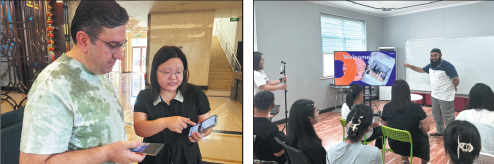
On a random morning recently, three different groups of foreign traders from Europe and the Middle East were seen in the lobby of a local hotel.
Among them was Hafiz Abubakr, a Pakistani businessman who now lives in London."I spent more than $60,000 in just five days," he says.
This was his first time in China, and he planned to make a "big investment" to sell wheeled luggage in the United Kingdom.
"This customer started to get in touch with us through Alibaba livestream," says Nancy Zhang, a salesperson with Omaska, one of the two local companies that Abubakr signed contracts with."It's not our biggest order. Two months ago, an Indian buyer ordered 10 containers of products."
She adds that the total sales of her company this year are expected to exceed 200 million yuan ($28.18 million), more than 30 percent higher than last year, and the majority of sales are from foreign trade orders.
With an area of only 50 square kilometers, Baigou has formed an industrial cluster that provides jobs for more than two million people nearby. Every year, in excess of 800 million bags and cases are sold to the world from this small town.
Despite the global economic slowdown, Baigou's total export figure for bags and cases in the first half of 2024 was 7 billion yuan, up over 17 percent year-on-year. Such figures have caused many to ponder the secret to the town's success.
Baigou's bag industry began in the 1970s when people sold handmade bags, along with toys and groceries, at fair stalls by the roadside. Over two decades, producers here tried to achieve mass sales by setting prices low. However, this path of development was unhealthy for the industry.
"Since we didn't attach much importance to branding and quality back then, it was difficult for small factories like us to make a profit as sales declined," says Wang Jinlong, founder of a leatherware company.
Things started to change in 2003.Over a period of five years, businesses in Baigou registered more than 1,400 brands. By building brands, this small town's influence in the bag market grew. With a household population of just 60,000, Baigou has formed a complete industrial chain for bag production, including raw-material supply, product design, manufacturing and sales.
In recent years, livestreaming commerce has grown rapidly in Baigou. Now nearly 10,000 live shopping events are held here every day, introducing products to customers from home and abroad through more than 20 languages.
The total output value of Baigou's bags and cases increased from about 10 billion yuan in 2020 to 41.9 billion yuan in 2023, over 70 percent of which was achieved through online sales.
At a cross-border e-commerce enterprise in Baigou, workers are packing goods, analyzing customer preferences, and adding women's bags to online shops accordingly. This company sells products to nearly 50 countries around the world through about a dozen international platforms, such as Shein, Amazon and Shopee.
"It's easier to peak online sales by providing quality goods that match the preferences of foreign buyers and the selling styles of international platforms," says the company's owner Wang Lei, who is also executive vice-president of the E-commerce Association of Baigou new area.
According to Wang Weinan, director of Baigou's bureau of investment promotion, led by the local government, a group of young Chinese entrepreneurs visited bag companies in seven countries last year to gain experience and seek larger overseas markets.
"We'll set off again immediately. We are heading to Japan and the Republic of Korea in September, and Indonesia and Malaysia in October," he adds.
Along with other 38 marketplaces, Baigou's bag market is part of China's market procurement trade mode pilot program.
Another foreign trader in the hotel lobby was Behnam Fadavi. This is the seventh year that the Iranian merchant and his brother have cooperated with Chinese companies. They mainly import backpacks and women's handbags from China to the United Arab Emirates.
Fadavi says that what he values most is good design. When asked how much he intended to spend in Baigou this time, the businessman says, "We don't have a purchasing limit, so long as the design is new and good."
Xinhua