Esprit de corps builds a desert economy









In recent years, the Xinjiang Production and Construction Corps has continuously improved people's livelihoods, focusing on pressing issues in areas such as housing, infrastructure, urban renovation, employment and transport.
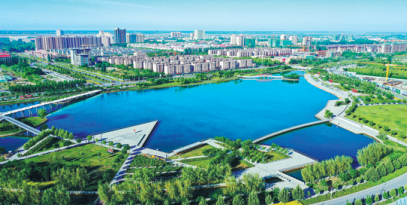
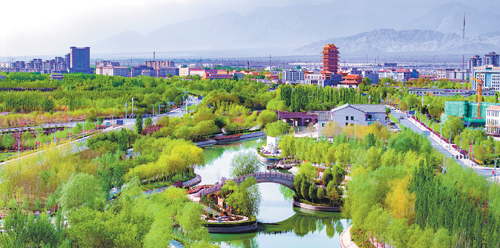
Today, the XPCC boasts vast fields with crisscrossing paths and factories dotting the vast desert. The distinctive urban system of the XPCC has begun to take shape, and workers and residents are experiencing significant changes in their way of life.
A herder from the Beitashan ranch of the Sixth Division under the XPCC has maintained a stable income since the transfer of land. The herder has a cleaning job at the ranch, which provides a fixed salary, and raises 20 sheep, two horses and four cows.
The spacious, well-lit kitchen and bathroom, complete with furniture and appliances such as a sofa, TV, and water heater, is the new home of a resident of the 51st Regiment of the Third Division under the XPCC. The resident said that running water and natural gas is available in the new house and "life is great".
When talking about the changes brought by the renovation of old residential communities, Wujiaqu city resident Xun Xiangping was full of praise.
"The exterior walls of the community have been repainted, and there are gardens and green spaces right outside the door. It's so convenient and comfortable to live here," said Xun.
Xun lives in the Yijingyuan community of Wujiaqu, which used to suffer from old underground pipelines and cramped spaces, causing many inconveniences. Wujiaqu, managed by the XPCC, merged several communities for comprehensive renovation, greatly improving residents' quality of life.
To address housing issues for workers and residents, the XPCC has also made progress in the construction of affordable housing projects, implemented public rental housing projects and carried out renovation projects for shantytowns, old residential areas, and dilapidated rural houses.
To date, more than 20,200 units of affordable housing have been built, and more than 137,000 units have been renovated. From 2021 to 2023, the XPCC renovated 253 old urban communities, benefiting 117,000 households.
As the XPCC accelerates new urbanization, city management is shifting from extensive development to an era of refined management. Through the internet of things and big data technology, cities managed by the XPCC are creating digital lifestyles that enhance residents' sense of happiness.
For example, Cocodala city has introduced more than 40 mobile services, including government services, convenience services and transportation. Shihezi city has built a "one-network management" platform for city governance, connecting 76 departments, enabling seamless data sharing and collaborative service delivery.
Transportation also has a significant effect on urban development and residents' happiness. In the past year, the XPCC implemented 56 key road projects, completing about 1,069 kilometers of new roads. They also advanced the construction of nine railways, and built or renovated 1,001 km of rural roads.
In 2023, the per capita disposable income of all XPCC residents reached 40,339 yuan ($5,762), surpassing the 40,000 yuan for the first time, with a year-on-year increase of 6.4 percent. Urban residents had an average disposable income of 46,485 yuan, up 5.5 percent from 2022, while residents in the brigades saw a 7.5 percent increase, with an average disposable income of 30,565 yuan.
The XPCC has also made efforts to improve the ecological environment to benefit local people in recent years. On the edge of the reclamation area in the Tarim Desert, Xinjiang Uygur autonomous region, poplar trees and tamarisks are thriving with lush, verdant foliage, forming an ecological protective forest that stretches nearly 200 km, and creating a green barrier that effectively prevents the merging of the Taklamakan and Kumtag deserts.
"In the past, sandstorms occurred every few days, and you couldn't see people within 30 to 50 meters. We tried planting trees to control the sand, but the survival rate was very low," said Wang Xianhua, a retired worker from the 31st Regiment of the Second Division under the XPCC.
The 31st, 33rd and 34th regiments of the Second Division under the XPCC are situated on the northeastern edge of the Taklamakan Desert and the southeastern edge of the Kumtag Desert. The narrowest point between these two deserts is less than 3 km. This area is arid with little rainfall and low vegetation coverage.
In 2000, the 31st regiment began afforestation, converting farmland back to forest, and in the gap between the two deserts, they planted a 1.1-km-long, 200-meter-wide shelter belt to control the wind and stabilize the sand. Subsequently, the 32nd, 33rd, 34th, 35th, 37th and 38th regiments continued greening efforts along national highways 218 and 315.
Over the years, workers and residents in the Tarim reclamation area have employed a three-tiered afforestation method combining trees, shrubs and grasses, creating a networked system of shelter belts. Around the regiments, they established a four-tiered ecological protection system, starting from the outer edge of the oasis and moving inward, consisting of desert ecological forests, windbreak and sand-stabilizing shelter belts, internal oasis farmland shelter belts, and specialized economic forests and residential area greenery.
Song Caifu, a staff member of the agricultural development service center in the 31st regiment, is one of the forest rangers involved in the construction and maintenance of the ecological barrier.
"Watching the desert turn green is my greatest source of pride. We must ensure that future generations don't suffer from the onslaught of sand and wind," Song said.
Song recalled replanting saplings in 2019."I had to walk over 30,000 steps in the desert each day to inspect pipes and install drip irrigation systems. But no matter how hard or exhausting it was, seeing this oasis grow day by day made all the effort worthwhile."
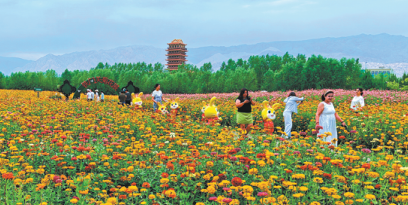
Today, while protecting against wind and sand and improving the ecological environment, workers and residents have also developed a desert economy as a key strategy for integrating ecological protection with rural vitalization.
They have cultivated economic crops such as black goji, sacsaoul, and fragrant pears based on local conditions, combining sand control with the development of specialty forestry and fruit industries.
In the lands of the various brigades of the 34th regiment, tens of thousands of nearly 3-meter-tall sacsaoul trees stand neatly arranged, protecting workers' farmlands and homes. Sacsaoul trees form extremely well-developed root systems, with a single tree's roots spreading over dozens of square meters underground, providing excellent windbreak and sand-stabilizing effects.
wangjinhui@chinadaily.com.cn