Earthquake relief efforts boost spirits in Xizang









Support from all walks of life provides vital aid, assistance to disaster-hit communities
On Jan 7, a 6.8-magnitude earthquake hit Dingri county in Shigatse of the Xizang autonomous region at 9:05 am.
Dingri is home to the northern base camp of the world's highest peak, Mount Qomolangma, also known around the world as Mount Everest.
The quake struck from a depth of 10 kilometers, while the epicenter was monitored at 28.5 degrees north latitude and 87.45 degrees east longitude, said a report issued by the China Earthquake Networks Center.
The epicenter is 34 km from Dinggye county, 36 km from Dingri county, 164 km from Shigatse city and 379 km from the regional capital Lhasa. There are seven villages located within a 5-km radius around the epicenter.
House collapses were reported in the affected areas including Dramso, Chulho and Tsogo townships, and communication and electricity in some areas were cut off. In addition to Dingri, another four neighboring counties — Lhaze, Sa'kya, Saga and Dinggye — were affected. Latest statistics show that a total of 126 people were killed and more than 300 were injured during the earthquake. The total number affected reached 61,500.
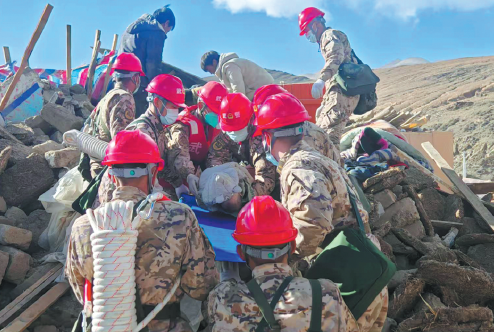
Rescue and relief efforts were immediately carried out to assist those affected by the earthquake.
The autonomous region's government and public institutions, as well as the business community and volunteer organizations, have launched an emergency response, mobilizing a great number of personnel, equipment and search dogs for rescue.
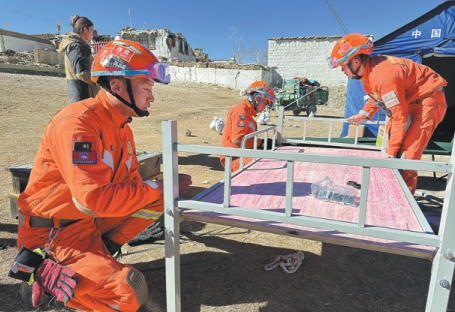
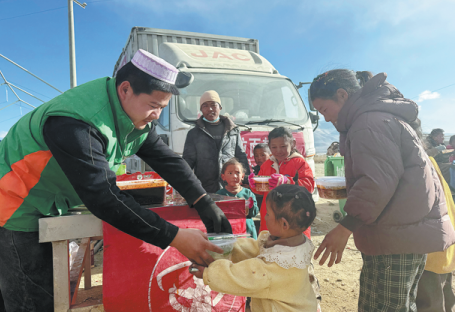
At a news conference on Jan 16, which was jointly held by Xizang's departments of emergency response, healthcare, transportation and housing, and the government of Shigatse, officials said a large number of supplies, including food, medicines, tents, beds, clothes, blankets, cooking utensils, fuel and heating equipment have been delivered to the residents of affected areas.
Wei Jun, deputy chief of the Xizang Department of Emergency Management, said at the conference that the current main task is to help the disaster-affected residents move into temporary shelters like assembled makeshift houses and tents, which are crucial to help people overcome the coldness of winter, as soon as possible.
He said materials that are capable of assembling 13,000 makeshift houses have been delivered to, or are on the way to, the earthquake-hit areas. More than 5,000 temporary houses are in place in these areas.
An official at the Xizang Health Commission said that two makeshift hospitals and 79 medical service stations have been set up in the areas to serve the residents in need. More than 200 medics were working at these facilities.
People from all walks of life and from across the country are doing everything they can to aid in the disaster relief efforts. Lhamo Drolma, an official at the Xizang Department of Civil Affairs, said that as of Jan 15, donations to the earthquake-affected areas amounted to 1.64 billion yuan ($224 million), including 1.53 billion yuan in cash and 106 million yuan worth of supplies.
It is worth mentioning that an oxygen supply cabin designed for high-altitude areas was used to relieve discomfort caused by hypoxia in the quake-affected areas of Dingri county. Jointly created by the Xizang branch of China Railway Construction Heavy Industry and the Xizang branch of China Anneng Construction Group, the oxygen supply cabin has greatly improved the working conditions for seismic rescue personnel in high-altitude environment and provided much-needed medical assistance spaces for disaster-affected people.
The cabin can accommodate more than 10 people at a time.
Rescuer Li Ruichao said he experienced chest tightness, dizziness and other discomfort after arriving in Zingkar village of Dingri. He underwent oxygen therapy in the oxygen supply cabin.
These efforts have led to the immediate and steady recovery of the quake-affected areas.
"Generally speaking, after staying here for half an hour, one can recover from discomfort and resume the seismic rescue tasks immediately," said Li.
Mobile communication signals in the most severely affected townships of Tsogo, Dramso and Chulho of Dingri county have all been restored by the night of Jan 7, the same day that the earthquake happened, said the region's telecom operators.
As of Jan 14, residents of the earthquake-hit areas in Dingri county, had moved into the more than 3,500 newly assembled temporary houses, and the rest were relocated to other temporary shelters like tents, according to local media reports.
A day after Guring village in Dramso township was struck by the earthquake, residents were all relocated to the temporary shelters. Despite temperatures as low as — 16 C, and the dire memory of the disaster, residents found their lives basically returned to normal thanks to the efforts of the government, rescuers and volunteers as well as other people and entities from all over the country.
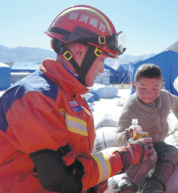
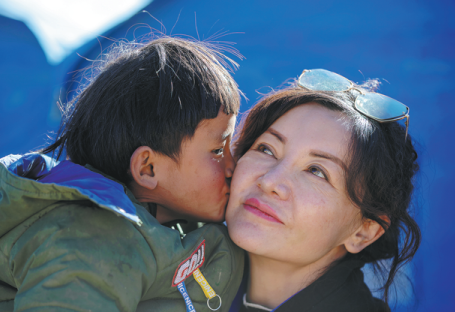
At a relief camp in the village, children waited in line for a meal of eggs, while older people tried to put to rest the memories of the disaster.
Sangye, a 55-year-old who held a prayer wheel and chanted scriptures, was among the seniors trying to pacify the others.
"Natural disasters can't be avoided. Although our house collapsed, my family was brought to a warm tent last night, and we were able to sleep," Sangye said, thanking relief and rescue workers for their untiring efforts to resettle people.
Unfortunately, it was an uneasy night on Jan 7 for Penba Norbu, deputy head of Dramso township. He recalled how he felt the strong shaking of his dormitory and noticed walls cracking before he ran outside. The township officials formed groups to check the villages and take part in the rescue.
When he arrived at Tsa village, Penba Norbu saw a child whose head was bleeding, some people with broken legs and those trapped under the debris of collapsed houses.
Six out of 464 people living in the village died, but the others were rescued. When a series of aftershocks rocked the area, he sent out a notice on WeChat, reminding villagers to take care and report any damage.
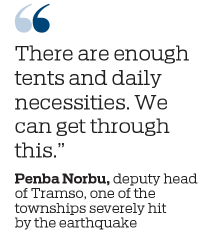
Penba Norbu said he felt relieved after the professional medical and rescue teams arrived, and the villagers were moved to temporary shelters. "There are enough tents and daily necessities. We can get through this," he added.
At a news conference held in Shigatse on Jan 8, Hong Li, head of the Xizang Emergency Management Department, said about 12,000 people participated in the rescue and relief efforts, including public security personnel, the armed police, forest firefighters, medics and the military. Together, they rescued 407 trapped individuals, he said.
A total of 187 relocation sites have been established in Dingri and 46,500 people have been moved. The 484 tourists who were visiting the county left the place as of the noon of that day, Hong added.
The relief tents are equipped with folding beds, cotton blankets, heaters, generators, stoves and emergency lighting, while people staying there have been provided with coats and warm footwear, besides food and medicines, the official said.
"The area is at a high altitude and is bitterly cold. We need to guarantee basic living conditions for the affected people, keep them warm and help them rebuild their homes as soon as possible," he added.
All tents and makeshift houses inhabited by residents affected by the earthquake in Dingri county were provided with a stable power supply by the afternoon of Jan 11, according to State Grid Xizang Electric Power Co.
In the wake of the earthquake, State Grid Xizang swiftly mobilized its resources to ensure affected areas received an uninterrupted supply of electricity, undertaking urgent repair and restoration tasks, a company representative said.
Despite harsh conditions and logistical challenges, the dedicated team worked tirelessly to restore electricity to the resettlement sites and provide essential relief to affected residents.
Wang Tianyou, an employee of the State Grid Lhokha Power Supply Co, said he and his colleagues are proud to have contributed to the rescue and recovery efforts for disaster-stricken communities.
Tan Xiangdong, deputy director of the Xizang Health Commission, said at the Jan 8 news conference in Shigatse that doctors from Beijing, Shanghai, and Chengdu in Sichuan province had arrived in the region to treat those in critical condition.
Special teams have also arrived to test water quality, disinfect the environment and promote health awareness among residents to prevent an epidemic, he added.
Days after the earthquake, easing the trauma of those who were affected by the disaster became a new focus of the local officials, medics and volunteers, as well as residents.
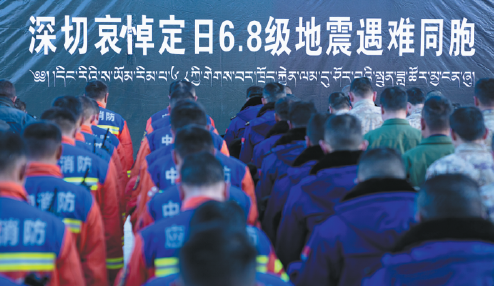
On the morning of Jan 13, a memorial service was held in Dingri county to mourn the victims.
At 9:30 am, hundreds of people, including government officials, rescue workers and local residents, attended the event in the county's Dramso township, the worst-hit area. They removed their hats and stood in silence for three minutes to honor the deceased.
In the aftermath, joint efforts from all sectors of society have been carried out for the rescue and relief work in the affected areas. Mental health relief teams have also been working diligently to ease post-disaster trauma.
On Jan 12, a special event was held at a resettlement site for quake victims in Changkar, Dingri. The Psychological Rescue Team of the Red Cross Society of China Sichuan Branch organized a group birthday party for six children born in January, which also attracted more than 30 children from three nearby resettlement areas.
Team members sang the birthday song, danced and cut a cake with the children inside a tent, creating a warm and joyful atmosphere despite the dusty and windy weather.
Changkar village in Dramso was one of the areas severely affected by the quake. Six villagers lost their lives, and most of the houses there were either severely damaged or destroyed.
Song Yao, head of the psychological relief team, said the birthday party aimed to help Changkar children recover from the trauma caused by the disaster and to bring warmth to others in the surrounding areas.
Song's team also organized soccer games, singing sessions and painting activities for the village children on Jan 12.
On Jan 13, Panchen Rinpoche, one of the most influential figures in Tibetan Buddhism, chanted scriptures and prayed with fellow monks for the earthquake victims, hoping that they recover quickly from the disaster and rebuild their homes, according to Xinhua News Agency.