Arab League, Jordan against forced displacement









The Arab League and Jordan have reiterated their strong opposition to the displacement of Palestinians from their land and within their territory, stressing that Gaza can be rebuilt without forcing its residents to leave, even as Israel continued operations in the occupied West Bank and prepared for more attacks.
During a meeting in Amman, Jordan, on Sunday, Arab League Secretary-General Ahmed Aboul Gheit and Jordan's Foreign Minister Ayman Safadi stressed that Gaza can be rebuilt without displacing residents, a Jordan's Ministry of Foreign Affairs and Expatriates' statement posted on Facebook said.
According to the statement, Aboul Gheit and Safadi said the establishment of an independent, sovereign Palestinian state along the 1967 borders, with East Jerusalem as its capital and based on the two-state solution, is the only path to achieving security, stability and comprehensive peace in the region.
They emphasized the importance of reinforcing the ceasefire in Gaza and ensuring the effective and sustainable delivery of humanitarian aid to the region. They also discussed ways to enhance joint Arab action, reviewed the latest regional developments, and talked about preparations for the emergency Arab summit scheduled early next month.
Gokhan Batu, an analyst on Israel studies at the Center for Middle Eastern Studies in Turkiye, told China Daily that the Arab League and Jordan's statements appear to be aligned with their historical mission and position.
Batu added that developments in the region have created significant pressure on the administrations of the Arab League states, including Jordan. Due to its demographic structure, Jordan perceives this situation as a threat to its domestic stability, Batu said.
Talking about Israeli attacks, Batu said: "Israel's actions can be interpreted through three key considerations: First, Israel sees opportunities in this chaotic period. The sensitivity of the ceasefire in Gaza provides a window for its operations in the West Bank. Second, removing these groups presents an opportunity for Israel to expand settlements northward. Finally, Israel aims to strengthen its deterrence through these operations."
At this stage, it can be argued that maintaining the ceasefire is becoming increasingly difficult, Batu said. However, it is challenging to establish a direct connection between Gaza and the situation in the West Bank, he added.
Safadi and Aboul Gheit also stressed the necessity of preventing further deterioration in the situation in occupied West Bank and called for an end to Israel's illegal measures that risk escalating tensions.
Israeli Prime Minister Benjamin Netanyahu warned on Sunday that Israel is "ready to return at any moment to intensive combat" in Gaza, telling cadets graduating from a military officers' course that "the operational plans are ready".
Addressing incoming officers in the Israel Defense Forces' Ground Forces, he repeated his promise of total victory in Gaza, quoted by The Times of Israel as saying: "All of our hostages, without exception, will return home. Hamas won't rule Gaza. Gaza will be demilitarized, and its fighting force will be dismantled."
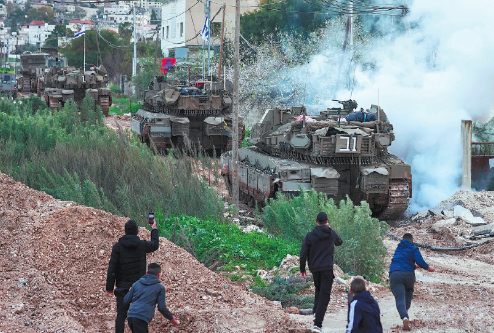
The Israeli military sent tanks into the occupied West Bank on Sunday for the first time in more than two decades, with Israeli government ordering forces to prepare for an "extended stay", according to an Al Jazeera report.
The Israeli military deployed heavy machinery in Burqin, a town in West Bank, where they were recorded digging up roads at the al-Abarah roundabout, leaving large mounds of dirt behind and the intersection unusable, Al Jazeera reported.
Contact the writer at mikegu@chinadailyhk.com