ICE AND SNOW RESOURCES HELP FUEL JILIN'S ECONOMIC RENEWAL









Northeast province implements policies to attract foreign investment
As part of Jilin's drive to enhance opening-up and upgrade local industrial layout, the Northeast China province is ramping up efforts to attract foreign investment while expanding the reach of policies that facilitate the business of foreign-funded enterprises.
According to the provincial government's recently-issued Several Measures to Further Promote High-Level Opening-Up Development, the policies cover 35 measures, including providing incentives, preferential treatment and support to foreign-funded enterprises, involving foreign investment projects, reinvestment by foreign businesses and foreign-funded research and development centers. The most representative measures include encouraging new projects by foreign investment and expanding the scope of foreign-funded investment.
As for foreign investment projects on the list issued by the central government, Jilin officials said there will be a 2 percent reward for enterprises whose actual foreign investment amount exceeds $5 million in the current year. Projects listed can also enjoy preferential policies such as the duty-free import of self-use equipment.
Additionally, Jilin will implement national treatment methods for foreign-funded enterprises, ensuring they participate equally in government procurement and standard-setting in accordance with laws and regulations. Furthermore, the province will continue to promote customs clearance facilitation and simplify customs procedures to provide a convenient business environment.
Sound industrial layout
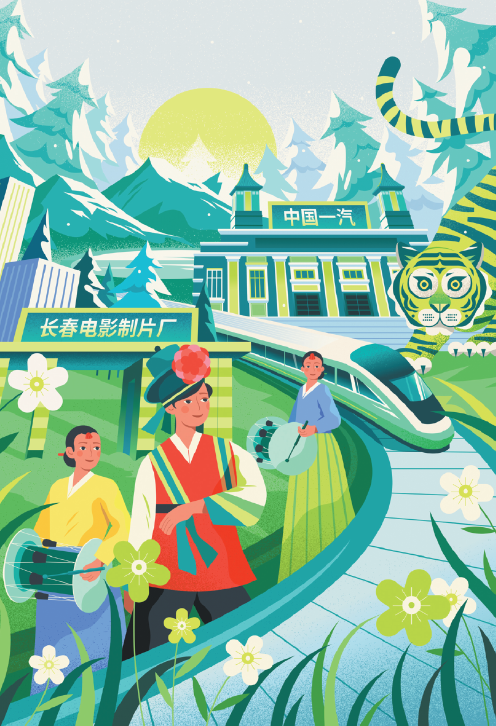
Known as the "cradle of China's automotive industry", Jilin witnessed the establishment of New China's first automobile workshop back in 1953.
The first car in New China, the Jiefang brand, and the first sedan, the Dongfeng brand, were both produced by FAW, which is based in Changchun, Jilin. FAW is known for production of the Hongqi sedan, the brand used by Chinese national leaders during their official visits.
In the early 1990s, the province began cooperating with Germany in the automotive and parts sectors.FAW-Volkswagen, as a model of Sino-German automotive industry cooperation, is one of the representative vehicle production enterprises in China.
Audi FAW NEV kicked off its premium electric platform production base at the end of 2024 in Changchun, a witness to the evolution of Sino-German automotive cooperation and the rapid advancement of China's automotive industry.
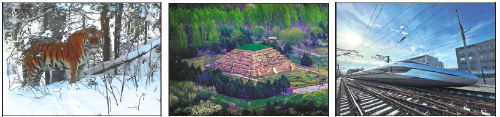
A prototype of the CR bullet train, capable of running at a speed of 400 kilometers per hour, was unveiled in 2024 by CRRC Changchun Railway Vehicles, a critical player for the R&D, manufacturing and export of rail passenger cars.
In the same year, the company's first independently developed hydrogen-powered urban train completed a test at a speed of 160 km/h, a breakthrough in the application of hydrogen energy in China's rail transit.
Chang Guang Satellite Technology, the country's first commercial remote sensing satellite company, was included into the Hurun Global Unicorn Index 2024. The Jilin-1 satellite constellation developed by the company, featuring more than 117 satellites, can provide frequent images of any location.
Jilin is located at the geometric center of Northeast Asia, with 1,452 kilometers of borders, 18 ports and four China-Europe freight train routes. As a key gateway for China's opening-up, it has established economic and trade relations with 196 countries and regions worldwide.The province has 12 national-level development zones, two comprehensive bonded zones and four cross-border e-commerce comprehensive pilot zones, showcasing a mature layout for opening-up.
The Changchun Automobile Economic and Technological Development Zone is China's only national-level economic and technological development zone named after automobiles. It houses six major automotive manufacturers and seven renowned automotive brands, with a total production value reaching 109.19 billion yuan ($14.94 billion) in 2024.
Jilin's industrial system is comprehensive, with a solid manufacturing base covering 40 out of 41 industrial categories and encompassing 31 major manufacturing industry categories.
The booming media industry in the province, driven by digital tools, is becoming a new factor to boost the local economy. Jishi Media is building up the Northeast Tiger and Leopard Culture International Communication Center. Based on large artificial intelligence models such as DeepSeek and Tongyi Qianwen, the company is turning itself into a key platform to popularize local resources and cultural heritage.Jilin Northeast Asia Publishing and Media Group has four major business segments of books, newspapers, printing, and distribution. Integrating the entire industry chain of editing and publishing, the company is distributing products all over the country.
Sustainable development
Since the winter of 2023, the cultural and tourism market in Northeast China has been heating up, and the hosting of the 9th Asian Winter Games drew attention to the region from all over the world. The influx of tourists has accelerated development of related industries such as catering, accommodation and entertainment. And new consumer demands continuously give rise to new industrial forms, promoting the optimization of local industries.
Tourists can taste Korean ethnic cuisine in Yanji, explore the forests of Changbai Mountain, and wander through the vast grasslands.They can also learn about movie history in the Former Site Museum of Changchun Film Studio. A comprehensive experience of natural landscapes, ethnic customs and varied cultures is accessible by traveling in the province.
During the 2024-25 winter season, Jilin received 170 million visits from domestic tourists, with their spending totaling 295 billion yuan, increasing 35 percent and 21 percent year-on-year respectively.
Leveraging the Goguryeo UNESCO World Heritage Site, the province is creating the G331 cultural heritage protection and utilization exhibition corridor, with visitor numbers at related scenic spots during the Spring Festival holiday increasing by 143 percent year-on-year.
Changchun Film Studio is regarded as a cradle of China's film industry, with 80 years of history. The Former Site Museum of Changchun Film Studio, combining patriotic education with film art, has become a popular destination to learn about the history of the film industry in China.
Its visitor numbers and total revenue increased by 66 percent and 69 percent respectively in 2024. Meanwhile, Chagan Lake ice fishing, a national-level intangible cultural heritage project offering winter fishing and hunting experiences, has become a prominent attraction for winter tourism.
The Northeast China region is a cradle for folk customs. The distinctive folk cultures of the Korean ethnic group, represented by the nongyue dance, and the Mongolian ethnic group, represented by Nadam celebrations, are highlights. To make contact with the "mysterious Oroqen ethnic group" has become another distinctive item in the ice and snow journey. Tourists from all over the country can experience ethnic customs and deepen their belonging in the Chinese nation.
In recent years, Jilin has promoted its attractions to global visitors by organizing diverse international sports, tourism, cultural, economic and trade activities centered on ice and snow. The China Changchun Jingyuetan Vasaloppet International Ski Festival, a world-renowned cross-country skiing event, has been held for 23 sessions.Also, the second FIS Snowboard Cross World Cup of the 2024-25 season was held in Beidahu of Jilin city. In 2024, cross-border tourism in the province increased by 161 percent year-on-year.
The cultural and tourism industry has had an immediate effect on the development of the economy and society. It is a barometer and indicator of economic development. Entering this new era, the all-around revitalization of Northeast China has continued to make progress. The trend of being more resilient, more dynamic and more positive has become obvious, officials said.
Colorful offerings
Covering an area of 187,400 square kilometers, Jilin is known for its precious and fertile black soil and is often referred to as "the nation's food basket" and "golden corn and rice-planting belt" due to its high productivity levels of its land.
Jilin's rice, fresh corn, miscellaneous grains and beans, beef and other high-quality foods have their fans all over the country. In 2024, Jilin's total grain output reached 42.66 billion kilograms, setting a new record. The province was the first in China to introduce regulations for the protection of black soil, with more than 2.73 million hectares of cultivation areas under protection.
Changbai Mountain, one of China's top 10 famous mountains, serves as the "water tower" of Northeast China, as it is the source of the Songhua, Tumen and Yalu rivers. The place nurtures the representative "three treasures" of ginseng, mineral water and Songhua inkstones. The mountain area has a long winter season with abundant high-quality snow. It belongs to the world's Golden Snow Belt along with the Alps in Europe and the Rocky Mountains in North America.
Jilin also boasts a forest coverage rate of 45.27 percent, according to the official data. In its eastern region, there are rolling mountains where tigers and leopards live. In the western part, there are grasslands and wetlands where cranes are often seen. In the central region, there are vast fertile fields with grains.
With forests along the borders and close to the sea, Jilin's Hunchun Port is bustling with imports and exports, witnessing a significant rise in cross-border e-commerce. More than 70 percent of emperor crabs on dining tables across the country come from Hunchun. Currently, the area is deepening cooperation across Northeast Asia, striving to become a key gateway for the Belt and Road Initiative.
Additionally, Jilin is a land with a revolutionary history, where countless martyrs sacrificed their lives to build the New China. Efforts are being made to curate modern and contemporary history exhibitions, protect and enhance the historical and cultural significance of Changchun's Xinmin Avenue, and construct a number of high-quality museums and exhibition halls.