US TARIFFS SHAKE UP ASEAN









Region's role in global supply chains in jeopardy
Editor's note: In this weekly feature China Daily gives voice to Asia and its people. The stories presented come mainly from the Asia News Network (ANN), of which China Daily is among its 20 leading titles.
Southeast Asian nations have been among the hardest hit by the latest US tariff rout across the globe, which has dealt a heavy blow to the region's export-reliant economies, and potentially jeopardizes their growing role in the supply chains of some of the world's most recognizable brands.
This will in all likelihood translate to higher prices for consumers in the US and beyond.
Washington on April 2 said it will slap levies of 46 percent on Vietnamese exports. Thailand will be hit by 36 percent duties and Indonesia 32 percent, as part of what the White House terms "reciprocal" tariffs that it says were determined by a calculation of levies and non-tariff barriers imposed on US exports.
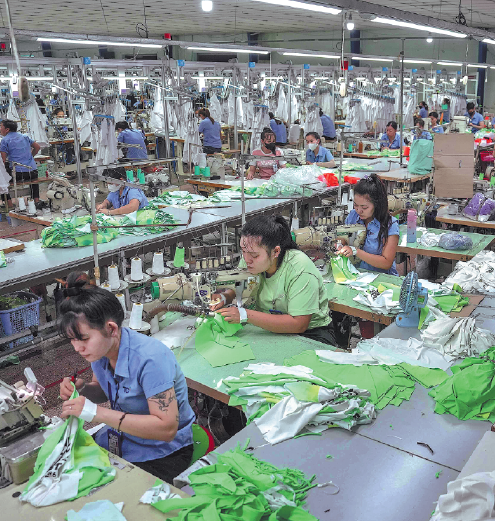
Vietnam produces about half of sporting giant Nike's shoes, hosts an Intel chip assembly plant, and is a major hub for the production of Apple Watches and AirPods. Major apparel retailers Abercrombie & Fitch and Lululemon rely heavily on both Vietnam and Cambodia for their production. Also, carmaker Tesla signed a $5 billion deal in 2022 to source nickel from Indonesia for its electric vehicle production.
The region's smaller economies were far from spared, with Cambodia at the receiving end of the highest reciprocal levy of all ASEAN countries at 49 percent, Laos at 48 percent, and Myanmar at 44 percent.
US consumers may also find higher price tags for Apple's iPhone and its range of Mac computers as well as the Microsoft Xbox gaming console, as a result of a 24 percent tariff on Malaysian goods.
Countries across Southeast Asia have in recent years sought to benefit from multinational companies as a production hub for everything from electronics to garments.
No winner
Vietnam's trade surplus with the US ballooned from the first iteration of US trade war that started in 2018.
This also leaves Hanoi particularly exposed to the impact of the Trump administration's tariff threats, just as it embarks on an ambitious domestic growth agenda.
Vietnam's exports to the US grew to 30 percent of its GDP in 2024, with electronics (43 percent) and textiles (24 percent) the biggest contributors.
"I opened my eyes this morning and was completely stunned. This 46 percent tax rate is beyond anything we could have imagined," Duong Thi Ngoc Dung, Ho Chi Minh City-based vice-chairwoman of Vietnam's Textile and Apparel Association, told Bloomberg on April 3.
"There is a high risk that many Vietnamese businesses will be forced to shut down, putting thousands of workers out of jobs," she said.
Major Malaysian exports, such as rubber gloves and a wide range of medical devices including ultrasound machines, pacemakers and hospital beds, will also be hurt by the 24 percent tariff rate.
The picture as a whole is gloomy, as the overall impact on Malaysia will also spread to domestic consumption, according to Socio-Economic Research Centre executive director Lee Heng Guie.
The economist said GDP will be affected by not just exports, but also incomes — as businesses related to the trade sector will see lower revenue, which will have a knock-on effect on employment and wages — as well as caution from investors.
"Even though Malaysia was hit by a lower rate than other regional peers, firms will still have to discount for softening global demand. So you may be able to get a larger slice of the pie, but the pie is now smaller," he said.
There is less clarity over whether Malaysia's growing semiconductor supply chain for devices such as iPhones and Mac computers falls under categories such as diodes, transistors and integrated circuits, which have so far been exempted from the reciprocal country tariffs.
"The greater impact will be a slowdown in investments in the electrical and electronics, or E&E sector, because of tariff uncertainties, which will likely last for the rest of 2025, if not beyond,"Malaysian Investment Development Authority board member Ong Kian Ming told The Straits Times, referring to expectations that the semiconductor sector will face further scrutiny from Washington down the road.
E&E makes up 40 percent of Malaysian exports, of which half are destined for the US.
Reactions in Asia
Malaysian Prime Minister Anwar Ibrahim, the current ASEAN Chair, called on Monday for Southeast Asian countries to "stand firm together" after they were among the hardest hit by US tariffs.
"We must stand firm together as ASEAN — with a population of 640 million and an economic strength that is among the top in the world," Anwar said at a prime minister's department staff meeting.
As ASEAN Chair, Malaysia seeks consensus among member states to establish principles of fairness and equality in international trade negotiations, including in ASEAN-US dialogue relations.
Vietnamese Prime Minister Pham Minh Chinh ordered up a task force to address the situation, state media said.He noted the country's 8 percent growth target for this year remained unchanged.
"Vietnam's export-driven growth model has been highly successful, attracting multinational companies …However, a 46 percent US tariff would directly challenge this model," said Leif Schneider, head of international law firm Luther in Vietnam.
Thai Prime Minister Paetongtarn Shinawatra said she hopes to bring down the 37 percent rate imposed on Thailand — far greater than the 11 percent it had expected.
"We have to negotiate and get into details," she said. "We can't let it get to where we miss our GDP target."
Thai economic growth has lagged regional peers, growing at 2.5 percent last year, held back by soaring household debt. It is hoping for 3 percent growth this year.
Malaysia, which was dealt a rate of 24 percent, announced it would engage with US authorities "to seek solutions that will uphold the spirit of free and fair trade."
Cambodia is facing tariffs of 49 percent that will hurt its garment and footwear industries and crushing hopes that it could attract investment relocating from other countries in the region.
It is a "very, very serious situation for the economy," said a Cambodia-based investment consultant who declined to be identified.
There is "nothing that Cambodia can offer as a negotiating tool, and will be at the back of a very long queue," he added.
The Straits Times, Singapore & The Jakarta Post, Indonesia