Human rights advance in leaps and bounds









Government of Xizang autonomous region has embarked on a wide-ranging program to improve people's lives, according to a white paper issued by the State Council
All-around and historic progress has been made in human rights in Southwest China's Xizang autonomous region, according to a white paper released in late March.
The document, titled "Human Rights in Xizang in the New Era", was released by the State Council Information Office at a news conference held on March 28 in Lhasa, capital city of the autonomous region.
The Communist Party of China and the Chinese government have implemented effective measures to develop the economy; improve living standards and people's well-being; promote ethnic unity and progress; and protect the basic rights of all the people in the region since Xizang's peaceful liberation in 1951, it said.
Since the 18th CPC National Congress in 2012, respecting and protecting human rights were made an important part of the CPC Central Committee's guidelines for the governance of the region, according to the document.
The CPC has maintained a people-centered approach to human rights and a commitment to ensuring human rights through development, and has vigorously promoted whole-process people's democracy, it said.
The Party has strengthened the legal protection of human rights, and coordinated efforts to increase people's civil and political rights, as well as economic, social and cultural rights, so as to achieve well-rounded development and common prosperity for all people from all ethnic groups, according to the white paper.
Today, Xizang enjoys political stability, ethnic unity, economic development, social harmony, and friendly relations among different religions, the document said.
Its environment is sound, and local people are content with their work and daily lives. This progress represents a remarkable achievement in protecting human rights on the snowy plateau, it said.
The white paper said residents in Xizang have enjoyed all-around democratic rights since the 1950s.
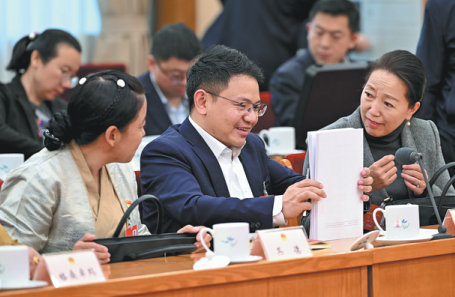
In Xizang, people's democratic rights are ensured with democracy practiced in the spheres of elections, political consultation, administration and supervision.
Local democracy is also ensured by the regional ethnic autonomy system. There are 42,153 deputies to people's congresses at four levels in Xizang, 89.2 percent of whom are Tibetan or from other ethnic groups.
As for economic and social rights, multiple sets of data showcased significant accomplishments.
The average life expectancy in the region rose from 68.17 years in 2010 to 72.19 years in 2020. The medical and health service has now achieved full coverage across the region.
Xizang's road network has nearly doubled in length in 12 years. Meanwhile, every town or township is covered by the 5G wireless network, with 2.14 million 5G mobile phone users.
By the end of 2019, all 628,000 people registered as poor in the region had been lifted out of poverty. In 2024, the per capita net income of those lifted out of poverty in Xizang increased by more than 12.5 percent.
Relocation initiative
Relocating residents from areas at high altitudes with an adverse natural environment to regions with better living conditions is an innovative practice in Xizang.
Rigzin is a resident in a new settlement in Gurum township, located in the district of Doilungdechen in Lhasa. The building where his family lives is a new, two-story Tibetan-style house equipped with electric appliances like a refrigerator, a washing machine, a big TV and air conditioners, as well as utilities such as water, electricity and gas.
Rigzin's family used to make a living herding on a pasture in Rongma township of Nyima county, which is a high-altitude area with difficult living conditions.
"Back in Rongma, a small TV set and a small machine for making butter were the only electric appliances in my family," Rigzin said."And there were no telecom facilities. If you wanted to make a phone call or use your WeChat, you needed to go to the township seat some 30 kilometers away."
In June 2018, a total of 262 households in Rongma, an area with an average altitude of more than 4,800 meters, were relocated to Gurum township at a much lower altitude.
According to Tashi Sangmo, head of the Rongma township government, Rongma is in the heart of the Changtang Nature Reserve, the largest of its kind in China.
Due to the high altitude, harsh natural environment and underdeveloped healthcare and public facilities, many residents in Rongma were victims of various high altitude-induced diseases. The average life span was lower than that of the autonomous region as a whole.
She said moving people out of the region is beneficial to both humans and the environment.
"We noticed Rongma has seen improvement in its environment over the past few years, with increases in vegetation and wildlife," the official said."And people relocated to the lower-altitude Gurum township now enjoy a better environment for their health and are being offered more job and business opportunities."
Both Rigzin and his wife Karma had developed chronic diseases in Rongma as a result of living for a long period of time in a high-altitude area.
As an arthrolithiasis patient, Rigzin has deformed hand joints, making it impossible for him to do heavy manual work.
Karma suffers from Kaschin-Beck disease, an illness unique to plateau regions. Fortunately, she received surgery in a hospital in Doilungdechen in 2024."The treatment cost a total of 100,000 yuan ($13,690) and about 80,000 yuan was covered by the government's new rural cooperative (medical care assistance system)," Karma said.
Despite their inability to do heavy work, Rigzin and Karma said their family revenue increased compared with that in Rongma.
"Back in Rongma, the per capita income of our family, mainly from animal herding, was about 15,000 yuan a year," Rigzin said. "And now the government pays every resident 15,000 yuan a year as an ecological compensation subsidy. And there are also dividends from the Rongma township cooperative."
Better access to education
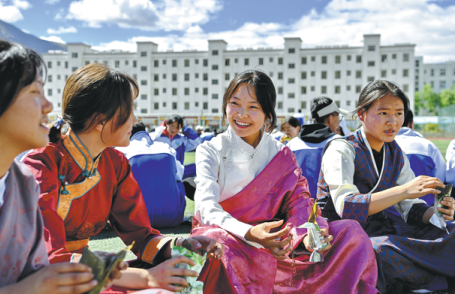
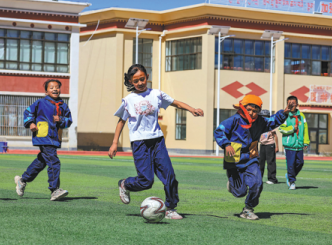
In Xizang, children's right to education has been protected and safeguarded.
Education is a cornerstone of sustainable development and human rights protection. Recognizing its importance, Xizang became the first provincial-level region in China to implement a 15-year publicly funded education system, ranging from kindergarten to senior middle school. This initiative has expanded access to education, particularly benefiting children in remote areas while reducing financial burdens on families.
By 2024, there were 3,618 schools at various levels and of different types, and 970,000 students on campus, accounting for more than 25 percent of Xizang's total population. The average length of education among new workforce entrants has increased to 13.1 years, reflecting a strong emphasis on cultivating a knowledgeable and skilled population.
Since 1985, Xizang has implemented a "Three Guarantees" policy for education. It provides food, accommodation and school expenses for preschool to senior middle school students who come from farming and herding households and impoverished urban families.
The annual subsidy under the framework has been growing steadily over the decades. The figure reached 5,620 yuan per person in 2024, benefiting 714,300 students.
Ngawang Wangdu is a teacher at Sinopec Primary School in Palgon county, Nagchu city. Working there for two decades, he said he is a witness to progress in local education. At his school, students are enjoying improved educational resources. The implementation of "Three Guarantees" has led to the overall development of the local education sector.
"The'Three Guarantees' policy has addressed parents' concern in tuition, accommodation and other schooling costs, increasing their willingness to send children to schools," Ngawang Wangdu said, adding that 100 percent of school-age children in the neighborhood have been enrolled.
"The guarantee of children's rights to education means unlimited possibilities for their future development," he said.
Protecting culture
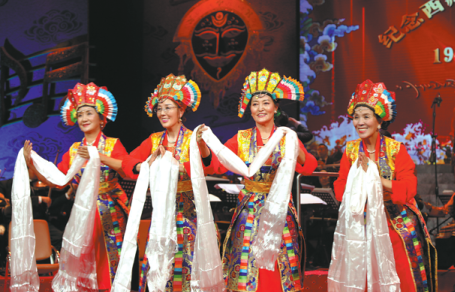
Moreover, the cultural rights of all ethnic groups in Xizang remain protected. For example, the Tibetan language is widely used in publishing, media and daily life. By the end of 2024, Xizang had 17 periodicals and 11 newspapers in Tibetan and had published 46.85 million copies of 8,794 Tibetan-language books.
The autonomous region puts a special emphasis on the protection of local cultural assets, especially those that fall into the category of intangible cultural heritage.
During 2012-24, the central government and the government of Xizang invested a total of 473 million yuan in protecting and developing ICH. The autonomous region now has 2,760 ICH items at various levels and 1,668 ICH inheritors.
The epic of King Gesar, the Tibetan Opera and the Lum medicinal bathing of Sowa Rigpa have been included in UNESCO's Representative List of the Intangible Cultural Heritage of Humanity.
The protection of the King Gesar epic is a shining example of Xizang's ICH protection. The tale of King Gesar is a great epic jointly created by people of multiple ethnic groups. It's now told and sung in Xizang and other provinces and autonomous regions in China.
The tales were mainly told by minstrels who traveled from place to place and gathered many interesting stories. As they told the tales of King Gesar, they would mix in stories they heard from different places and share them with the local herders. The epic of King Gesar is considered one of the longest "living" epics in the world. For centuries, storytellers have continued to sing it, weaving their own narratives into the ancient tale.
Sonam Tashi has worked at the Gesar research center of the Xizang Autonomous Region Academy of Social Sciences since 2016. He said he has been a witness to the protection and development of the art over the past decade.
"A decade ago, performers would simply sing verses from the King Gesar epic while seated or standing, often found in pastoral areas," he said. Today, however, these guardians of the Gesar epic tradition can be seen in teahouses, restaurants and theaters in urban areas, thanks to the sustained support from governments at all levels. And young inheritors of this art are adding some modern elements into the ancient epic.
The researcher said central and local authorities have attached great importance to the protection and development of the epic. Under their support, the Xizang Academy of Social Sciences has devoted great energy to preserving and passing down this ancient art. It has collected various versions based on narrations by artists in different regions of the country and published 23 copies of works relating to King Gesar tales.
In Xizang, residents also enjoy freedom in religious beliefs. Xizang is home to more than 1,700 sites for Tibetan Buddhism, providing ample space for the spiritual practices of the Tibetan people. Furthermore, monks and nuns are now included in comprehensive social welfare programs, including medical insurance, pensions and accident insurance — an unprecedented development in Tibetan Buddhism.
The government has also enacted policies to ensure that religious practices and religion-related traditions are respected and integrated into the broader societal framework. These measures affirm China's commitment to upholding the religious and cultural rights of all ethnic groups within its borders.
The news conference for the release of the white paper was attended by more than 130 journalists from more than 50 domestic and overseas media outlets.
At the conference, Gama Cedain, chairman of the Xizang autonomous region, said that there is "no perfect tense but progressive tense instead" in the field of human rights protection. He added that "concerted efforts will be taken to write a new chapter of human rights protection" to meet the expectations of all people in Xizang.