Cultural heritage bolsters tourism in Shanxi









Province's renowned history, attractions prove a hit with tourists during recent May Day holiday
During the five-day May Day holiday, spanning from May 1 to 5, tourists to the North China province of Shanxi were offered an impressive experience due to the local tourism practices to integrate history and modernity, cultural heritage with natural attractions, and enhanced services for visitors.
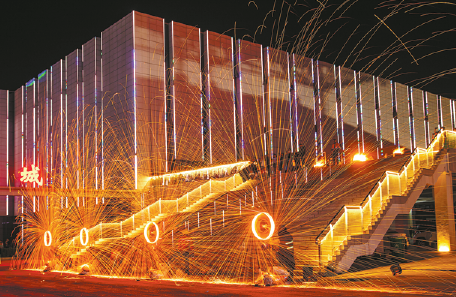
On the evening of May 2, after a tight day's schedule touring the ancient city of Datong, Zhang Yifan, a tourist from Beijing, joined a crowd of people gathering in a square in front of Yongtaimen — the southern gate of the city wall. They were waiting for the opening of a performance show entitled Because of Datong.
When the setting sun's glow on the glazed roof tiles of the gate tower became dim, the show began with a shout: "Open the gate!"
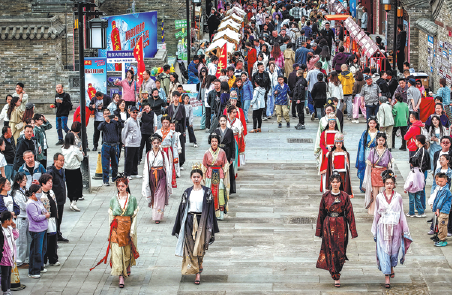
The city gate opened, men and women, wearing clothes of the ancient Xianbei ethnic group, were found dancing on both sides of a flagstone walk leading to the interior of the city wall. Audience members were ushered into a show area.
When seeing the show beginning with craftsmen working on a cliff with chisels and a caravan approaching with the ringing of camel bells, Zhang immediately realized it is about the city's heyday in history and what made it a cultural landmark in Shanxi and even the entire country.
As the show reveals, one and a half millennia ago, Datong was standing at the crossroads of cultural exchanges between the East and West, and among various ethnic peoples inside China.
Datong used to be the national capital of the Northern Wei Dynasty (386-534), which was founded by the Xianbei ethnic people from China's northeast. Generations of emperors and rulers showed their willingness to integrate with the cultures of other ethnic groups, especially the Han, and to embrace the Buddhist culture coming all the way from the west via the ancient Silk Road.
A shining example of this cultural exchange move was the construction of the Yungang Grottoes, a Buddhist cave art treasure trove carved out of the mountain cliffs in the western suburbs of Datong.
When Datong served as the national capital of Northern Wei, it was also an important hub of the Ancient Silk Road. Along with the trade of commodities, Buddhism came via this traditional trade route from its original birthplace in South Asia.
In the process of spreading the Buddhism religion to China, which began during the Eastern Han Dynasty (25-220), the dissemination of Buddhist culture, represented by the construction of caves and temples, came to its peak during the period spanning from the fourth to the sixth centuries.
At that time, Mogao in Dunhuang, Gansu province; Yungang in Datong, Shanxi province; and Longmen in Luoyang, Henan province represented the highest level of Buddhist cave art.
In Datong, between the fifth and sixth centuries, local artisans constructed dozens of cliffside caves and hundreds of smaller niches in Yungang. They then decorated the spaces with colored sculptures, patterns and architectural structures. Consequently, Yungang became an enduring legacy of history, culture and art.
After watching the show, Zhang said he had a better understanding about Datong and Yungang Grottoes. "This show, leveraging modern digital technologies and a novel narrative style, presented vivid stories on what makes Yungang a cultural landmark and Datong an enticing tourist attraction," Zhang said.
Integrating tradition with modernity was the theme of many tourist destinations in Shanxi during the May Day holiday.
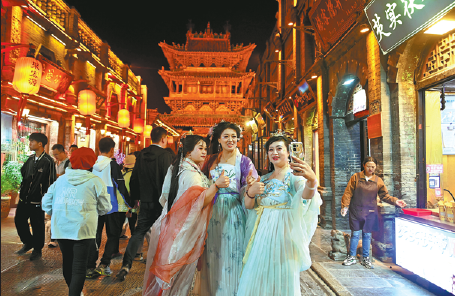
In the ancient city of Pingyao, which had been the hub for business activities of the renowned Shanxi merchants, a number of events, including intangible cultural heritage-featured parades and digital light shows, were added to the regular reality show Pingyao Revisited during the May Day holiday, giving tourists an immersive experience on what happened in history.
The city of Pingyao in Jinzhong is said to have the best-preserved historical cityscapes in China. It looks much the same as it looked during the Ming (1368-1644) and Qing (1644-1911) dynasties.
That was also the period when the Shanxi merchants, also known as Jinshang merchants, reached their peak of prosperity.
The Jinshang merchants are said to have dominated the foreign trade business in northern China during the two dynasties, and Pingyao was the hub of their operations.
The Jinshang merchants' success in business has left a precious legacy in Pingyao and its neighboring areas, including the grand family courtyards, and the premises of various old firms, like China's earliest banking firms known as piaohao and armed courier businesses called biaoju.
Many tourists attended an intangible cultural heritage-featured parade on May 1.When strolling through the well-protected ancient streets, they were amazed by the number of premises of old Jinshang firms. "I'm sure that Pingyao definitely outnumbered any city in China in this aspect," said one of the tourists at the parade.
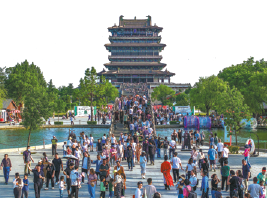
Due to its rich portfolio of offerings to tourists, Pingyao received more than 120,000 visits on May 1 alone.
Shanxi's improved infrastructure and services prove to be another draw to tourists during the May Day holiday.
A traveler surnamed Zhang said what prompted him to make the decision to visit Shanxi this time is the easy access to charging facilities along the roads and in scenic areas, because he plans to travel with an electric car.
"I learned that charging stations for electric vehicles are easily available in Shanxi," he said. "But I was still surprised when I saw free charging services are offered at the parking lots of many scenic areas."
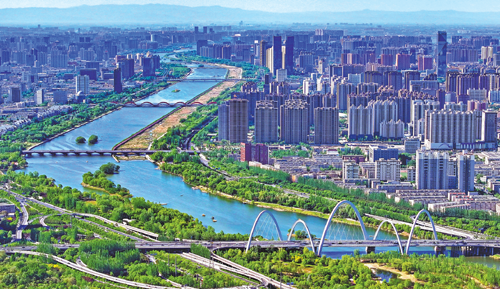
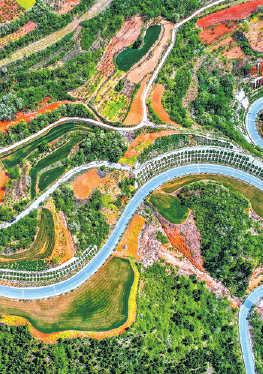
To facilitate travel in Shanxi, the province has built three major sightseeing highways to link thousands of destinations along the Yellow River, the Taihang Mountains and the Great Wall. With a total length of about 13,000 kilometers, the three highways — called Yellow River No 1, Taihang Mountains No 1 and Great Wall No 1 respectively — became fully operational last year.
Upon the full operations, the transport authority of Shanxi immediately released a three-year action plan to improve infrastructure and services of the roads.
This plan's basic requirements for the highways include a service area to be established every 25 km and a charging station every 50 km.
In Datong, to meet the demand of the increasing number of tourists, the urban bus service was extended to 10 pm during the May Day holiday. And three shuttle bus lines were added to transport tourists to hot destinations like Yungang Grottoes.
During the holiday, Shanxi received more than 22 million domestic tourist visits, increasing 22.4 percent from the same period of last year, according to the Shanxi Provincial Department of Culture and Tourism.
The total revenue generated from domestic tourists reached 16.03 billion yuan ($2.22 billion), growing 27.61 percent year-on-year.
Although provincewide statistics for inbound overseas tourists are not available yet, many individual tourism operators in Shanxi reported steady growth in this aspect.
Some overseas tourists said that the fame of Shanxi as a cultural tourism destination has already been known by many and the province is highly preferred when they make plans to visit China.
An Australian tourist named Emily, for instance, was among the many foreign visitors to Pingyao ancient city. She said she was there to experience the culture relating to the famed Jinshang merchants.
In addition to drawing in tourists from its traditional markets, Shanxi is expected to attract visitors from a new source country — Mongolia — this summer.
On May 2, a group of visitors representing the North Asian country's tourism operators began a business research tour of Datong. They were there to explore the local tourism resources before the opening of the Datong-Ulan Bator flight on June 3.
Zhang Qi contributed to this story.