Counting on courage to record history









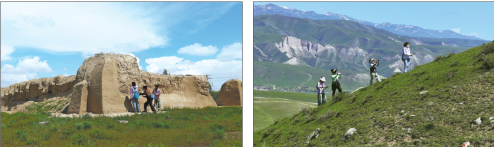
Despite difficulties during the fourth national census of cultural relics in Horgos, Xinjiang Uygur autonomous region, which borders Kazakhstan, members of the city's census team have completed most of their field work and achieved fruitful results.
Their stories epitomize the experience of more than 600 census takers working in Xinjiang to record the cultural treasure in their hometowns.
The team has four women members with an average age of 43. They have investigated and recorded the findings of 14 sites already known in the previous census, except one that is still inaccessible on a snowy mountain. They have added 18 new sites to the list.
"Although our team members are not young, we have managed to complete our tasks by crossing high mountains and traversing deep ravines just like our young counterparts," says Zhang Huiling, the 52-year-old leader of the team, who is also head of the cultural heritage department of Horgos' culture and tourism bureau.
Team members say local people have played a significant role providing information for finding new sites.
"We have actively promoted our work among the public by spreading brochures introducing the census," says Yan Ping, a 36-year-old member of the team.
"To our surprise, we received a great deal of feedback from people about the possible cultural remains they had noticed in daily life and then we investigated the sites. As of now, most of the new sites we have found came from local people's reports."
Yan and her colleagues re-discovered the site of a karun, meaning in Manchu language a sentry post, which was established in border areas during the Qing Dynasty (1644-1911). It was recorded as disappeared in the third national census of cultural relics, which was carried out from 2007 to 2011.
According to Yan, they followed previous satellite positioning data on the site to look for it in July last year but initially couldn't find traces. Unwilling to give up, they began to scour the surrounding areas.
After two days they found remains of a building with a format very similar to other existing karun in Horgos. Its relative location to reference points, like a cliff, a snowy mountain and trees, was similar to its old photos.
After consulting experts, they were sure this is the karun they were seeking.
"A main reason we could find it this time is that we have more advanced equipment than before, which could guide us anywhere we wanted to go to in a more accurate way. This discovery is a big reward for us in this census," says Yan.
Many of Horgos' sites are in remote mountainous areas where few people can access. Team members have to improvise. They often saddle up and ride horses or hike in the mountains. In border areas they are often accompanied by frontier guards.
Yu Baoqin, a 52-year-old team member, says it was not easy to complete their tasks. When their field work started in July last year, they visited mountains with no trees to provide any shade. Locusts were rampant, posing a big challenge.
"When we visited sites on the Hantian Mountain last year, every time we opened a bowl of instant noodles, locusts jumped into our faces and into the bowl. It seemed to be a competition between people and the locusts to see who could gain the first bite," says Yu.
Riding horses sometimes can become a challenging experience for them as well. Zhang recalls last July, they went to check some unknown tombs local people reported to them on a mountain. On their way back, they were riding horses on narrow mountain paths, but one of the horses was suddenly startled and began to buck. A team member on it fell off. Luckily, he was not badly injured.
Worried that it would startle other horses, team members all jumped down from their horses and began to hike in the mountains by themselves. The horses, instead, were led by herders to return. Finally, team members spent more than five hours walking back to the city.
"Although we met a lot of problems, we viewed them as nothing but experiences in life and haven't felt frightened to face them. We are so honored to be members of the census and all we have thought is to accomplish the tasks in a satisfying way," says Yan.