Decoding the sands of time









Taklamakan Desert slowly gives up its secrets as census takers tackle unforgiving environment, Wang Ru reports in Hotan, Xinjiang Uygur autonomous region.
The Taklamakan Desert, China's largest desert and located in the Xinjiang Uygur autonomous region, was once the central stage for numerous legends along the ancient Silk Road. However, as environmental conditions changed, the once-thriving human settlements were abandoned, standing in the wilderness with only sand and wind as companions. It wasn't until the late 19th century when foreign explorers ventured into the desert that people began to uncover many of the cultural heritage sites.
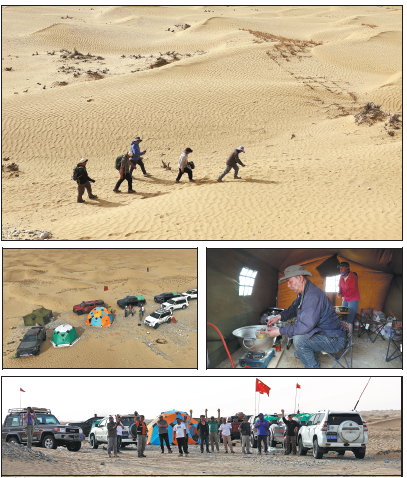
After more than a century, professionals are visiting these sites one by one. They tread on the sand, braving the strong winds and enduring the scorching sun overhead, as they strive to investigate and document their conditions.
They come from a special team of the fourth national census of cultural relics in China, which records the cultural heritage in the Taklamakan Desert, especially in its heartland.
"Many of the sites lie deep in the heart of the desert, inaccessible by regular vehicles like those used by other census teams," says Hu Xingjun, head of the team, who is also a researcher at the Xinjiang Institute of Cultural Relics and Archaeology. "We organized a special team focusing on these sites. This ensures we fulfill the census mandate of 'taking census of all those that should be covered'."
The national census began in 2023 and will end next year. Field investigations started in May last year in Xinjiang. Census takers visit the sites to survey and map them using real-time kinematic devices, take aerial photos with drones and other photos recording details, measure the size of sites, collect specimens, and record detailed information in the census database.
With more than a dozen members, the team's work has started recently and will run until the end of May.
Team members must repeatedly enter the desert, often for several days or even weeks at a time. They usually invite experienced drivers to form a fleet of sport utility vehicles stocked with fuel, food and water, equipment and daily necessities to enter the desert's depopulated zones, rest in tents, and survey each site firsthand.
Careful planning
Matyvsup Emirhazi, a 31-year-old team member and a researcher at Hotan Museum, says they have to make careful plans for each day in the desert, follow the plans strictly, and carry supplies for several extra days beyond their initial estimates to deal with unexpected situations.
In a desert where footprints are easily left, they have paid close attention to not leaving traces in their photos to ensure the effect. "We usually take the panoramic photo at first, without entering the site. After that we set foot on the sites to measure and take photos of details," says Matyvsup.
They are especially careful with the ecological protection in the desert by burning the garbage and taking away those items that cannot be incinerated, ensuring human garbage does not pollute the environment.
At the end of every day's work, they report the all-clear with satellite phones to cultural heritage authorities, providing reassurance.
Team member Matkasim Tumir, 57, says they often have to save water, a scarce commodity.
"With limited loading capacity, we have to take a lot of supplies. For example, driving 1 kilometer requires 1 liter of gasoline, so we need to carry a lot. We also need to load daily necessities like tents, desks, chairs and pans. Therefore, there is not much room for water. We each are allocated two bottles of drinking water one day, and 10 pieces of disposable wet tissues every two days for cleaning," he says.
Sometimes camels join to help carry goods and materials. "In the past when we didn't have SUV, camels played a major role helping us carry goods. Now I still believe they are the best partners in the desert, because vehicles can break down or struggle with sand dunes, but camels' adeptness at traversing the desert is unmatched," says Matkasim, who is richly experienced in desert archaeology.
But the animals are not always reliable, since they can be unpredictable.
For example, during their visit to Yuansha site, an ancient city from the Warring States Period (475-221 BC) to the Han Dynasty (206 BC-AD 220), now in the heartland of the Taklamakan Desert, the team encountered a series of unexpected challenges in March. Two of their camels suddenly bolted, one of the vehicles malfunctioned and was unable to tackle dunes and to round it off, a sandstorm hit the team.
Faced with these circumstances, team members had to solve the problems one by one. Camel handlers went to pursue the runaway animals and team members leveled the sand dunes to facilitate the vehicle's passage.
The team members still had to complete their census tasks, and walked to many of the sites when their vehicles went back to transport supplies the camels left. They seized every minute to work, as they could not take the risk of staying too long in the desert with their limited supplies of only 15 days. Finally, they spent 14 days completing the work, and took a census of all the 79 small sites covered in Yuansha ruins spreading over an area nearly 100 kilometers long.
Being persistent
Ediris Abdurusul, a distinguished 74-year-old archaeologist with a remarkable track record of leading close to 100 expeditions in the desert over the past 46 years without any accidents, has also joined the team as a consultant. He led many breakthrough discoveries in Xinjiang, including the excavations of the Xiaohe cemetery, a site of Bronze Age cultural remains from 4,000 to 3,400 years ago. He was also known for the discovery of a naturally preserved female mummy called the "princess of Xiaohe" two decades ago.
He says people often say the Taklamakan Desert is "the sea of death", referring to its harsh environment for human habitation. However, historically, that's not true, as the desert once had many rivers that nourished people for millennia.
In his surveys in the Keriya River Basin in the desert, he found sites from 4,000 years ago to the Tang Dynasty (618-907). He also found ancient people preferred to live by the river, adapting their habitats continuously in response to changes in the watercourses over time.
With the rich cultural remains still at the sites, they have carried out a series of explorations and excavations in the desert.
"Doing archaeological work in the desert is very tough, but we have done a good job over the decades and found quite a number of ancient sites. Teamwork has played a major role in the process," he says.
The first time Matkasim entered the desert for archaeological studies was in 1990, when he followed Ediris to study the Niya ruins, remains of Jingjue state on the ancient Silk Road from the 2nd century BC to the 5th century AD. Since then, he had participated in multiple desert archaeological studies under the guidance of Ediris, and has grown into a mature desert archaeologist.
"Working in the desert is so arduous that I have considered giving it up, since we often had to stay in the desert for 20 or 30 days," says Matkasim. "I guess I could persist because I still love the work, the surprises of seeing ancient sites are always impressive."
He has learned a lot from Ediris. "His conscientiousness and attention to details have greatly influenced my style of work.
"When organizing an academic trip to the desert, he always considers every detail, down to reminding us of taking away cigarette ash. Learning from him, I was very careful when I led the teams. Over the past 35 years, my teams have remained accident-free as well," he says proudly.
On Jan 1, Matkasim retired from the culture and tourism bureau of Hotan prefecture, but he agreed to help complete the census work until next year. He has imparted much of his experience in the desert to Matyvsup, a young member of the team.
"Before this census, I worked in the Hotan Museum and was engaged with display design," says Matyvsup. "I had never had a chance to see cultural heritage in the desert as a local of Hotan. Therefore, I have been very excited participating in the census work, which allows me to have hands-on experience working in the desert.
"I treat Matkasim as my teacher. I have not only learned professional knowledge from him, but also his experience living and working in the desert, which can hardly be taught without practice. Now he has retired, and I will carry on the torch to give full play to what I have learned," he adds.
Contact the writer at wangru1@chinadaily.com.cn