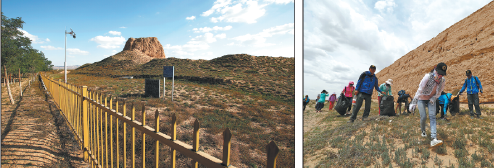
Great Wall explorer records unmapped ruins









Enthusiast spends 200 days a year in the wild taking notes and photos
Gripping self-made hiking poles, Li Shixiang picks his way along the sheer cliffs of the Yellow River's Heishan Gorge in Zhongwei, Ningxia Hui autonomous region, under the blazing sun.
The 49-year-old amateur archaeologist is searching for the remains of the Great Wall, which was mainly built on mountain ridges across northern China using rammed earth, stones and bricks.
The UNESCO World Heritage Site was constructed over the course of 2,000 years. It worked as a fortification system to defend against nomadic invasions.
Over the past two decades, Li has traveled over 300,000 kilometers looking for the architectural wonder's ruins that are unmarked on maps.
He has amassed more than 100,000 photos and countless notes and drawings.
"I'm afraid of falling behind the pace at which the Great Wall ruins are disappearing. So I'm racing against time to document them with words and pictures," Li said.
Northwest China's Ningxia is home to 1,500 km of the Great Wall segments built from the Warring States Period (475-221 BC) to the Ming Dynasty (1368-1644), earning it the title "Museum of the Great Wall".
Growing up near an ancient city in Ningxia's Haiyuan county, Li enjoyed climbing the walls with friends and picking up ancient coins and arrowheads in his childhood.
As an adult, he ran a printing shop in the county. Business trips to rural areas frequently exposed him to scattered ancient ruins of the walls and watch towers, igniting his passion for Great Wall research.
"The Great Wall is more than an ancient structure. It embodies the resilience and spirit of the Chinese nation," Li said.
Despite lacking formal academic training, Li developed his own methodology through hands-on experience: pinpointing potential locations by cross-referencing historical records with satellite imagery before conducting field surveys.
Upon discovering a new ruin, he would record its position coordinates and document his findings with photographs and written notes.
All the data would be used to refine his Great Wall distribution map.
To date, Li has traveled to almost all regions with Great Wall remains, including Beijing, Inner Mongolia autonomous region, as well as Gansu, Shaanxi and Hebei provinces. He has found over 1,000 km of previously unrecorded sections.
The Great Wall distribution map in Li's computer is dotted with over 10,000 marked spots, each representing a site he has visited.
Li spends over 200 days a year in the wild. He often sustains himself on just one daily meal, usually fried cakes or instant noodles, and sleeps in his car at night.
Every new discovery relieves his exhaustion.
In the summer of 2019, after a five-hour drive through the Gobi Desert in Gansu, he found an ancient city completely untouched without a single footprint in sight. "I was so excited that tears streamed down my face," he recalled.
The adventures also bring risks: Li has encountered wolves, fallen into ice holes, and broken his eyebrow bone.
In 2020, while riding a motorcycle along a gully in a remote canyon, his front wheel sank into soft soil and threw him three meters down a slope.
He blacked out for several minutes before waking up to a sharp pain and realizing his big toe had been broken.
"Just a little further, my head would have smashed into a rock," Li said. "No one would probably have found me if I died there."
However, Li said these physical hardships and injuries pale in comparison to the pain he feels when he sees damage to the Great Wall caused by a variety of factors, ranging from human activities to natural disasters.
Over the years, Li has dedicated himself to protecting the enduring cultural treasure in every way possible.
Many previously unknown Great Wall sections have been placed under protection thanks to the clues he reported to authorities.
He has also persuaded farmers not to remove wall materials for their sheep pens, stopped tourists from climbing watch towers, and reported construction projects that harm the ancient fortifications.
Li's efforts earned him official recognition as a Great Wall guardian in 2016.
For Li, the Great Wall has become an integral part of his life.
He particularly enjoys the nights when he stays alone in the wild — the Great Wall is silhouetted against the starry sky, and nothing but the whisper of the wind and hum of insects fill his ears, bringing him a deep sense of peace.
"I feel as if the Great Wall is watching over me, just as I watch over it," he said.
Xinhua contributed to this story.
Contact the writers at pengchao@chinadaily.com.cn