Transplanting the East in Europe









Chinese influences, such as pagodas, paintings and ancient temples, inspired a desire in elitists for exotic garden designs, Zhao Xu reports.
William Chambers (1723-96)wrote in his landmark Enlightenment-era book, A Dissertation on Oriental Gardening (1772): "Such is the common scenery of the Chinese gardens … their artists never fail to improve upon its singularities: their aim is to excite a great variety of passions in the mind of spectators; and the fertility of their imagination, always upon the stretch in search of novelty, furnishes them with a thousand artifices to accomplish that aim."
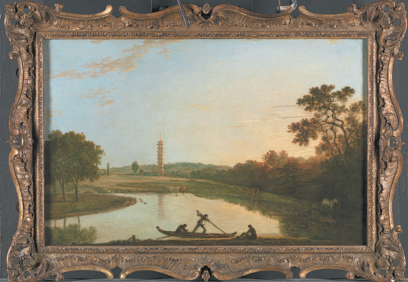
More than two decades earlier, Chambers made three trips to Canton (Guangzhou, Guangdong province) between 1745 and the early 1750s. The journeys left a lasting impression on the rising star of British architecture, who was officially named Architect to the King by George III in 1761.The following year, he was tasked with designing the Great Pagoda at the Royal Botanic Gardens, Kew, in southwest London, for Princess Augusta, the king's mother.
Today, the 10-story, 50-meter-tall pagoda still stands as one of the earliest major examples of Chinoiserie architecture in Britain — a European style inspired by Chinese and broader East Asian motifs.
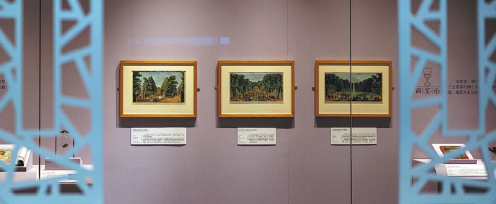
An oil painting of the pagoda by celebrated 18th-century British landscapist Richard Wilson is now on display at the Suzhou Museum in Suzhou, Jiangsu province, in the From the Humble Administrator's Garden to Monet's Garden exhibition, which explores the rich, two-way aesthetic and philosophical exchanges that shaped garden designs across the East and the West.
"Chambers' garden was modeled after the Great Bao'en Temple constructed in China during the 15th century. Since the original Great Bao'en Temple was largely destroyed in the ensuing centuries, Wilson's painting serves as a powerful reminder of the grandeur of its model," says Lyu Wentao, the exhibition's curator.
"It's also worth noting that the Great Bao'en Temple was largely funded by Zheng He, the renowned Ming (1368-1644) voyageur whose explorations reached as near as Southeast Asia and as far as East Africa, and represented a high point of exchange between ancient China and the rest of the world."
The Kew Gardens Pagoda is another fruit borne of such exchanges. "Jesuit missionaries began arriving in China in the late 16th century, and their travel accounts and letters home provided some of the earliest European descriptions of Chinese architecture, including the gardens. This imagery was further enriched by porcelain, lacquerware and woodblock prints imported to Europe by the British, Dutch, Swedish and other East India companies," says Lyu.
Chambers traveled to China as a trading agent for the Swedish East India Company.
In 1603, the Dutch East India Company (VOC) captured a Portuguese galleon near Singapore, richly laden with Chinese goods, including porcelain adorned with intricate garden scenes. The episode revealed not only the inevitable clash between a rising maritime power and an established one, but also the immense allure of Chinese wares.
Chinoiserie emerged and reached its peak in 18th-century Europe as a romanticized reinvention of China, reflecting the era's fascination with the exotic.
This aesthetic preference found expression in garden designs through the addition of Chinese-inspired "architectural follies" — such as the pagoda — into otherwise European landscapes.
Superficial as it may seem, the transplantation of the Chinese garden into European soil unfolded amid profound social, political and philosophical transformations, serving as both a catalyst for and a reflection of those changes, says Lyu.
"Parallel to the rise of Chinoiserie was the emergence of the English garden as a distinct style — an antithesis to the formal, symmetrical French gardens where everything was arranged along central axes," says Lyu, pointing to Versailles, the ultimate showcase of French Baroque architecture.
With its grand scale, strict geometry, and long avenues and sightlines radiating from the palace, Versailles proclaimed the monarch's absolutist power over man and nature, something the British would come to reject in their search for a national identity, in a century that included the execution of King Charles I of England and the ensuing establishment of a constitutional monarchy.
As a political and cultural statement, the English garden embraced a more naturalistic, irregular and free-flowing design, allowing for meandering paths, gently rolling lawns, and asymmetrical vistas that suggest a more harmonious relationship between man and nature.
All that sounds familiar to someone living in 17th and 18th-century China, when garden-building became a fad among the literati elite and in the city of Suzhou, which boasted a long tradition of literati culture and became the place for Chinese gardens.
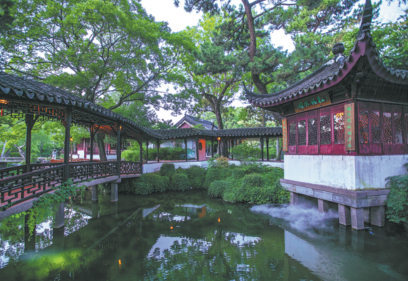
Of the many exquisite gardens built in the city throughout ancient China, one rises head and shoulders above the rest — Zhuozheng Yuan, or the Humble Administrator's Garden, next door to the Suzhou Museum.
Its first owner, Wang Xianchen, who constructed the garden between 1509 and 1525, had endured enough trials in court life to deem himself "zhuozheng", or clumsy with politics. Resigning from office at 40, Wang spent the rest of his life in relative seclusion in his manicured version of nature, which comprised meandering waterways, sculpted rockeries, contorted trees, and pavilions and halls of serene elegance.
"'Though wrought by human hands, it appears in every way a creation of nature itself' — this, as set forth by a revered Ming Dynasty garden designer, became the ultimate benchmark of the literati garden," says Lyu.
"His theory rested on a time-honored belief among ancient China's educated elite that communion with nature fosters introspection and self-cultivation, virtues at the very heart of Confucian moral life."
Other currents of thought long woven into Chinese culture also flowed through the gardens, where the hushed passage of the seasons invited visitors to attune themselves to nature's spontaneous rhythms and contemplate its impermanence — reflections at the heart of Taoist and Zen Buddhist philosophy.
Many of these subtle layers of meaning may have eluded Chambers. He admired the variety of Chinese garden scenes, yet felt compelled to classify them in A Dissertation on Oriental Gardening as "the pleasing, the terrible, and the surprising".
"The first of these are composed of the gayest and most perfect productions of the vegetable world, intermixed with rivers, lakes, cascades, fountains and water-works of all sorts, being combined and displayed in all the picturesque forms that art or nature can suggest," wrote Chambers, who went on to elaborate the second category.
"Their scenes of terror are composed of gloomy woods, deep valleys inaccessible to the sun, impending barren rocks, dark caverns and impetuous cataracts rushing down the mountain from all parts."
Needless to say, "the surprising", as mentioned here by Chambers, corresponds to the sudden appearance of a pavilion at the turn of a bend, or a framed view opening through a wooden latticed window or a moon gate — the interplay between concealment and revelation that lends a Chinese garden its sense of wonder and perpetual discovery.
"While the Chinese scholar-officials who were often behind these gardens regarded their carefully constructed microcosms of ever-shifting views as prose imbued with the lyricism of poetry, their Western counterparts perceived them instead as staged dramas, orchestrated to evoke the full spectrum of emotions one might encounter in a Shakespearean theater," says Lyu.
Keeping that in mind, the Kew Gardens Pagoda, rising prominently above the pastoral setting of the British countryside, stands as a striking exclamation point, a bold architectural proclamation within an otherwise tranquil landscape.
Contact the writer at zhaoxu@chinadaily.com.cn